
Why Resistance Training Matters During GLP-1 Weight Loss
GLP-1-based medications such as semaglutide and tirzepatide can produce substantial reductions in body weight by decreasing appetite and energy intake. However, weight loss does not consist exclusively of body fat. Some lean tissue may also be lost during significant calorie restriction, making muscle preservation during GLP-1 weight loss an important consideration. Some lean tissue may also be lost during significant calorie restriction.
Preserving skeletal muscle is important because muscle contributes to strength, mobility, glucose metabolism, physical function, and long-term independence. This becomes particularly important in older adults and in patients who already have low muscle mass or strength.
Resistance training during GLP-1 weight loss provides a direct mechanical stimulus that encourages skeletal muscle to maintain and adapt its contractile tissue even while body weight is decreasing.
Unlike aerobic exercise alone, resistance exercise specifically challenges muscles against an external load. Dumbbells, resistance machines, bands, cable systems, and appropriately selected body-weight exercises can all provide this stimulus.
The objective is not necessarily bodybuilding or maximizing muscle size. For many patients undergoing medical weight management, the priority is preserving functional muscle, maintaining or improving strength, and ensuring that as much of the weight reduction as reasonably possible comes from excess adipose tissue rather than valuable lean tissue.
Resistance exercise works best when combined with adequate protein, appropriate nutrition, sufficient recovery, and an individualized rate of weight loss.
7 Proven Resistance Training Strategies During GLP-1 Weight Loss
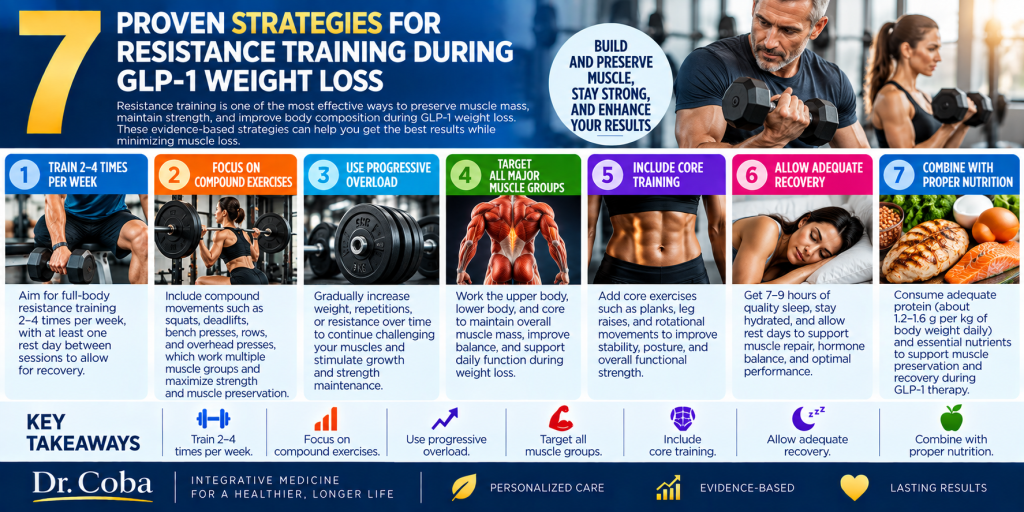
1. Prioritize the Major Muscle Groups
An effective resistance-training program should provide adequate stimulus to the major muscle groups rather than concentrating exclusively on smaller or more visible muscles.
Exercises that involve the legs, hips, back, chest, shoulders, and arms can help preserve strength and functional capacity throughout the body. Compound movements are particularly useful because they involve several joints and muscle groups simultaneously.
Depending on the patient’s experience and physical limitations, examples may include squats or chair squats, leg presses, hip hinges, rows, chest presses, overhead presses, pulldowns, step-ups, and appropriately selected carrying movements.
Exercise selection should be individualized. A younger patient with extensive training experience may tolerate free-weight exercises that would be inappropriate for an older adult with impaired balance, osteoarthritis, cardiovascular limitations, or little previous resistance-training experience.
Machines and resistance bands can provide effective alternatives when greater stability or simpler movement patterns are desirable.
The objective of resistance training during GLP-1 weight loss is not to perform the greatest possible number of exercises. It is to provide a safe, repeatable mechanical stimulus to enough skeletal muscle to help preserve strength, function, and lean tissue as body weight decreases.
2. Train Each Major Muscle Group at Least Twice Per Week
Consistency is more important than occasional high-intensity workouts. For many adults, training the major muscle groups on at least two nonconsecutive days each week provides a practical foundation for maintaining or improving muscular strength.
A full-body resistance program performed two or three times per week can be especially practical for patients undergoing medical weight loss. This approach allows the major muscle groups to receive repeated training stimuli without requiring daily gym sessions.
More experienced individuals may prefer split routines in which different muscle groups are trained on different days. Either approach can be effective when weekly training volume, exercise intensity, progression, and recovery are appropriate.
Recovery between sessions is important because resistance exercise temporarily stresses muscle tissue. Adequate protein, total nutrition, hydration, and sleep help support the adaptive process that follows training.
Patients who are new to resistance exercise should generally begin with manageable training volume rather than attempting an advanced program immediately. Exercise frequency and workload can then increase progressively as strength, technique, and tolerance improve.
Regular resistance training during GLP-1 weight loss provides repeated mechanical signals that help skeletal muscle remain functionally active while body weight and calorie intake decline.
3. Use Progressive Overload to Maintain the Training Stimulus
Skeletal muscle adapts to the demands placed upon it. If resistance training remains unchanged for months, an exercise that was initially challenging may eventually become too easy to provide the same adaptive stimulus.
Progressive overload is an important component of resistance training during GLP-1 weight loss because it gradually increases the training demand as strength and exercise tolerance improve. This can be accomplished by increasing resistance, repetitions, sets, range of motion, exercise difficulty, or—in appropriate patients—training frequency.
Progression does not need to be aggressive. Small increases performed consistently can be more sustainable than large jumps in workload, particularly when calorie intake is reduced and recovery capacity may be temporarily affected.
Technique should remain a priority. Increasing resistance at the expense of movement quality can increase injury risk and may shift the exercise away from the intended muscle groups.
Patients should also distinguish normal muscular effort from concerning symptoms. New chest discomfort, unusual shortness of breath, dizziness, fainting, or significant musculoskeletal pain warrants stopping the activity and appropriate medical evaluation.
Properly applied progressive overload makes resistance training during GLP-1 weight loss an evolving stimulus rather than a static routine, helping preserve strength and skeletal muscle as the patient’s body weight and physical capacity change.
4. Train With Enough Resistance to Challenge the Muscles
Resistance exercise must be sufficiently challenging to stimulate adaptation. Simply moving very light weights for repetitions that require little effort may not provide enough stimulus to preserve or improve muscular strength.
The appropriate intensity for resistance training during GLP-1 weight loss varies substantially between individuals and should reflect current strength, experience, and physical capacity. A load that is challenging for a beginner may be far below what an experienced lifter requires, which is why resistance should be selected according to current strength and exercise experience rather than using the same weight for everyone.
A practical approach is to perform a set until the final repetitions feel meaningfully difficult while maintaining proper technique. Training to complete muscular failure is not required for every set, particularly in beginners, older adults, or patients with medical or orthopedic limitations.
Different repetition ranges can improve strength and muscle when the resistance and effort are appropriate. This allows exercise programs to be adapted to patient preferences, equipment availability, joint tolerance, and training goals.
As body weight decreases, patients should pay attention to whether their training performance remains stable. A persistent decline in strength may indicate inadequate recovery, insufficient nutrition, overly aggressive calorie restriction, or the need to modify the exercise program.
Appropriately challenging resistance training during GLP-1 weight loss helps provide skeletal muscle with a clear reason to remain strong and functionally active while the body is operating in an energy deficit.
5. Combine Resistance Training With Adequate Protein
Resistance exercise provides the mechanical stimulus for skeletal muscle, while dietary protein supplies the essential amino acids needed for muscle protein synthesis, repair, and adaptation. These two components work together particularly well during periods of calorie restriction.
When appetite is substantially reduced, patients may unintentionally consume less protein along with fewer total calories. This can become especially important during rapid or substantial weight loss.
Protein needs should be individualized according to age, body size, kidney function, activity level, nutritional status, baseline muscle mass, and the degree of calorie restriction.
Protein distribution can also matter. Consuming meaningful amounts of high-quality protein across several meals provides repeated opportunities to stimulate muscle protein synthesis rather than concentrating nearly all daily protein in one meal.
Protein supplements may be useful when reduced appetite makes adequate intake from whole foods difficult, but they should complement rather than automatically replace a nutrient-dense diet.
Combining adequate protein with resistance training during GLP-1 weight loss provides both the nutritional substrate and mechanical stimulus needed to support muscle preservation, recovery, strength, and physical function.
6. Protect Recovery With Adequate Nutrition, Hydration, and Sleep
Resistance training during GLP-1 weight loss creates an important stimulus for muscular adaptation, but adequate recovery is necessary for the body to respond effectively to that stimulus. Inadequate nutrition, dehydration, insufficient sleep, or excessive training volume can interfere with recovery and reduce exercise performance.
This becomes particularly relevant during GLP-1 therapy because appetite suppression may make it difficult for some patients to consume sufficient calories, protein, fluids, and micronutrients.
Hydration should receive particular attention when reduced appetite is accompanied by nausea, vomiting, diarrhea, or substantially lower food and fluid intake. Dehydration can contribute to fatigue, dizziness, and impaired exercise performance.
Sleep also plays an important role in physical recovery. Consistently inadequate or disrupted sleep can affect training performance, appetite regulation, glucose metabolism, and the ability to maintain an exercise program.
Rest days should be incorporated according to training intensity, experience, age, and recovery capacity. More exercise is not automatically better if accumulated fatigue causes strength and performance to decline.
Effective resistance training during GLP-1 weight loss therefore requires enough recovery resources to allow skeletal muscle to respond to training while the patient continues reducing excess body fat.
7. Monitor Strength and Performance as Body Weight Decreases
During resistance training during GLP-1 weight loss, the number on the scale cannot determine whether skeletal muscle and physical performance are being adequately preserved. For this reason, strength and functional performance should be considered alongside changes in body weight and body composition.
Simple training records can provide valuable information. Tracking resistance, repetitions, sets, and exercise performance over time makes it easier to recognize whether strength is stable, improving, or consistently declining.
Depending on the patient, additional assessments may include grip strength, chair-rise performance, walking speed, balance, or other measures of physical function. Body-composition measurements may provide complementary information when interpreted appropriately.
Some fluctuation in exercise performance is normal. However, a persistent decline in strength accompanied by fatigue, poor nutritional intake, rapid weight loss, or reduced physical function deserves closer attention.
The treatment plan may need adjustment if the patient is losing weight rapidly while becoming progressively weaker. Nutrition, protein intake, calorie deficit, medication tolerance, recovery, and the resistance-training program should all be considered.
Monitoring resistance training during GLP-1 weight loss helps ensure that treatment is producing more than a lower body weight—it helps determine whether strength, muscle function, and physical capacity are being preserved as excess adiposity decreases.
A Practical Resistance Training Plan During GLP-1 Weight Loss
Resistance training during GLP-1 weight loss does not need to be complicated to be effective, especially when the program is individualized and performed consistently. For many previously sedentary adults, a simple full-body routine performed consistently can provide an appropriate starting point.
A practical program may begin with two full-body sessions per week on nonconsecutive days. Each session can include exercises for the legs, hips, back, chest, shoulders, and arms.
Examples may include a chair squat or leg press, hip hinge or another hip-dominant movement, seated row, chest press, pulldown, shoulder press, and an appropriately selected core or carrying exercise.
Beginners may start with approximately 1–3 sets per exercise, using a resistance that allows controlled repetitions with proper technique while still making the final repetitions challenging. Training volume and resistance can then be increased gradually as strength and tolerance improve.
The exact number of repetitions is less important than using appropriate resistance, maintaining good technique, and progressively challenging the muscles. Different repetition ranges can be effective when sets are performed with sufficient effort.
Older adults, patients with limited mobility, significant orthopedic disease, cardiovascular conditions, balance impairment, or little previous exercise experience may benefit from professional assessment and supervised instruction before progressing to more demanding exercises.
The best program is one the patient can perform safely and consistently. Sustainable resistance training during GLP-1 weight loss should progress with the individual’s strength and capacity rather than following a rigid one-size-fits-all routine.
Why Resistance Training Is Especially Important for Older Adults
Aging is commonly accompanied by progressive changes in skeletal muscle mass, strength, and physical performance. When substantial weight loss is added to this process, preserving functional muscle becomes particularly important.
Older adults may begin GLP-1 therapy with lower muscle reserves than younger patients. Reduced appetite and calorie intake can create an additional challenge if protein consumption and resistance exercise are inadequate.
Resistance training during GLP-1 weight loss can help older adults maintain strength, which has implications far beyond appearance. Skeletal muscle supports walking, balance, rising from a chair, climbing stairs, glucose disposal, recovery from illness, and the ability to perform normal activities independently.
Resistance exercise can be adapted to a wide range of physical abilities. Machines, resistance bands, supported exercises, chair-based movements, and appropriately selected free-weight exercises can all be used depending on strength, mobility, balance, and orthopedic limitations.
The objective should not be to push every older patient toward high-intensity athletic training. Rather, the program should provide a sufficient and progressively appropriate muscular stimulus while minimizing unnecessary injury risk.
For older adults, resistance training during GLP-1 weight loss should therefore be viewed as part of a broader healthy-aging strategy designed to reduce excess adiposity while preserving strength, mobility, metabolic health, and physical independence.
The Bottom Line on Resistance Training During GLP-1 Weight Loss
GLP-1-based medications can produce substantial reductions in body weight, but the quality of that weight loss matters. Preserving skeletal muscle and strength should remain an important objective while excess body fat is being reduced.
Resistance exercise provides the mechanical stimulus that encourages skeletal muscle to remain active and adapt during an energy deficit. The program does not need to be complicated, but it should consistently challenge the major muscle groups and progress appropriately as strength improves.
Adequate protein, nutrient-dense nutrition, hydration, sleep, and recovery complement the training stimulus. When these factors are neglected, exercise performance and the ability to preserve muscle may suffer.
Monitoring should extend beyond the scale. Strength, resistance-training performance, body composition, mobility, and physical function can provide important information about whether weight reduction is occurring without an unnecessary decline in functional muscle.
This is particularly important for older adults and patients who begin treatment with low muscle mass, limited strength, or other risk factors for sarcopenia.
Ultimately, effective resistance training during GLP-1 weight loss helps shift the objective from simply becoming lighter to reducing excess adiposity while preserving the strength, muscle function, mobility, and physical capacity required for long-term health.
Pingback: Creatine During GLP-1 Weight Loss: 7 Powerful Benefits
Pingback: Hydration During GLP-1 Weight Loss: 7 Essential Tips
Pingback: Blood Sugar Management Fort Lauderdale: 7 Powerful Strategies
Pingback: Protein Intake During GLP-1 Weight Loss: 7 Proven Tips