
Understanding Low Testosterone and Metabolic Health
Low testosterone and metabolic health are closely connected in men. Testosterone influences muscle mass, body-fat distribution, energy metabolism, sexual function, and overall physical performance, while metabolic conditions can also influence testosterone production and availability.
Obesity, insulin resistance, type 2 diabetes, poor sleep, and reduced physical activity are frequently associated with lower testosterone concentrations. At the same time, reduced testosterone may contribute to unfavorable changes in body composition, including decreased lean muscle mass and increased visceral fat.
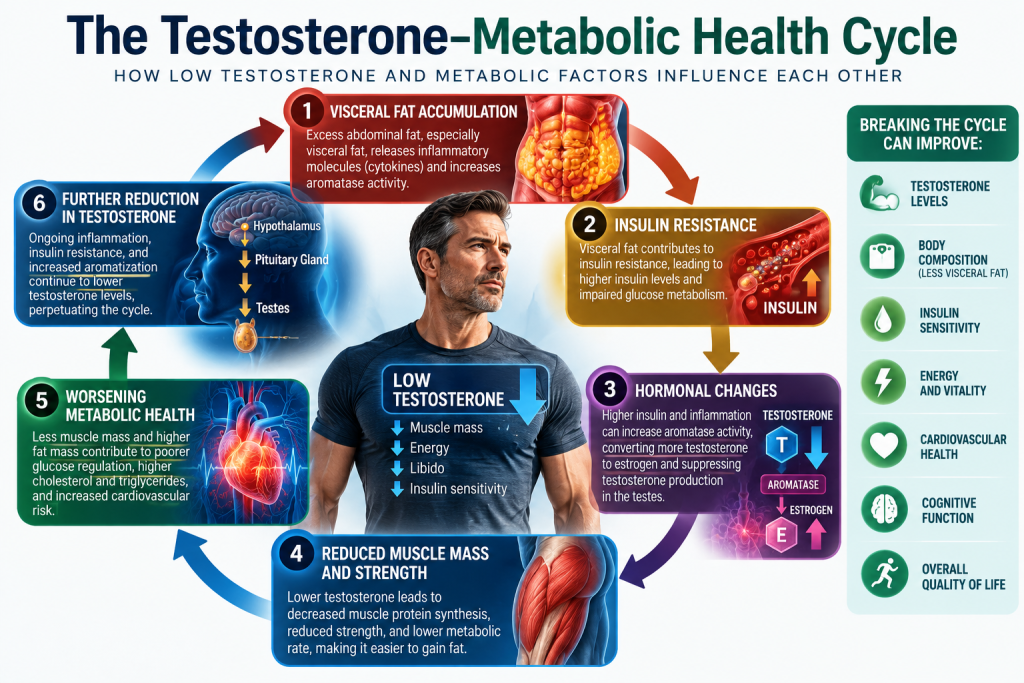
This relationship can become a cycle in which metabolic dysfunction and hormonal changes reinforce one another. However, a low testosterone result should not automatically be assumed to be the primary cause of metabolic problems. A comprehensive evaluation considers symptoms, repeat hormone measurements, body composition, medications, sleep, and metabolic risk factors together.
Understanding these connections can help identify potentially modifiable factors and determine whether lifestyle intervention, treatment of an underlying metabolic condition, testosterone evaluation, or another clinical approach is appropriate.
7 Important Connections Between Low Testosterone and Metabolic Health
1. Visceral Fat and Testosterone Can Influence Each Other
Visceral fat is the metabolically active fat that accumulates around internal abdominal organs. In men, excess visceral adiposity is associated with lower testosterone concentrations and a less favorable metabolic profile.
Adipose tissue is biologically active and participates in hormone metabolism, inflammatory signaling, and insulin regulation. As body fat increases, hormonal changes can occur that may contribute to reduced testosterone production or altered testosterone availability.
The relationship can also work in the opposite direction. Lower testosterone may be associated with reduced lean muscle mass and increased fat accumulation, potentially making body-composition improvement more difficult.
This does not mean that excess body fat is always caused by low testosterone or that testosterone therapy is automatically appropriate for men with obesity. Rather, body composition and hormonal status should be evaluated together when symptoms or laboratory findings suggest a possible testosterone deficiency.
2. Insulin Resistance Is Associated With Lower Testosterone
Insulin resistance occurs when cells become less responsive to insulin, requiring the body to produce more insulin to maintain normal blood glucose levels. It is a central feature of metabolic syndrome and often precedes the development of type 2 diabetes.
Men with insulin resistance and metabolic syndrome frequently have lower total testosterone concentrations. One contributing factor can be lower levels of sex hormone-binding globulin (SHBG), which can reduce measured total testosterone and complicate interpretation of hormone results.
Insulin resistance is also commonly associated with visceral obesity, chronic low-grade inflammation, and reduced physical activity. These factors may interact with the hypothalamic-pituitary-testicular axis and contribute to changes in testosterone production.
For this reason, evaluating low testosterone and metabolic health may include assessment of fasting glucose, hemoglobin A1c, body composition, waist circumference, lipid levels, and other metabolic risk factors when clinically appropriate.
3. Type 2 Diabetes and Low Testosterone Often Occur Together
Men with type 2 diabetes have a higher prevalence of low testosterone than metabolically healthy men. Obesity, insulin resistance, chronic inflammation, sleep disorders, medications, and other health conditions may all contribute to this association. This is another reason low testosterone and metabolic health should be considered together rather than evaluated as completely separate issues.
Diabetes can also affect sexual function through mechanisms that are independent of testosterone. Vascular disease, endothelial dysfunction, and peripheral neuropathy can impair erectile function even when testosterone levels are adequate.
Therefore, symptoms such as reduced libido, fatigue, or erectile difficulties should not automatically be attributed to testosterone deficiency in a man with diabetes. Appropriate evaluation may include metabolic assessment together with properly performed testosterone testing.
Identifying both hormonal and metabolic contributors allows treatment to address the underlying clinical picture rather than focusing on a single laboratory value.
4. Muscle Mass Supports Metabolic and Hormonal Health
Skeletal muscle plays an important role in glucose disposal, insulin sensitivity, physical function, and overall metabolic health. Maintaining adequate muscle mass becomes increasingly important as men age because age-related muscle loss can contribute to reduced strength and metabolic dysfunction.
Testosterone supports muscle protein synthesis and helps maintain lean body mass. When testosterone is persistently low, some men may experience decreased muscle mass, reduced strength, and changes in body composition.
Resistance training provides an important nonpharmacologic strategy for preserving or increasing muscle mass while also improving insulin sensitivity and physical performance. Adequate protein intake, recovery, sleep, and appropriate caloric intake also contribute to maintaining lean tissue.
For men being evaluated for low testosterone, muscle loss should therefore be considered within the broader context of physical activity, nutrition, aging, metabolic health, and hormonal status.
5. Poor Sleep Can Affect Testosterone and Metabolic Health
Sleep plays an important role in testosterone production, glucose regulation, appetite control, and metabolic recovery. Inadequate or disrupted sleep can adversely affect several of these processes simultaneously.
Testosterone secretion is closely linked to normal sleep architecture. Chronic sleep restriction may contribute to lower testosterone levels, while insufficient sleep can also impair insulin sensitivity and promote changes in appetite and body weight.
Obstructive sleep apnea deserves particular attention because it is common in men with obesity and metabolic dysfunction. Symptoms may include loud snoring, witnessed pauses in breathing, morning headaches, daytime sleepiness, and unrefreshing sleep.
When evaluating low testosterone and metabolic health, identifying and treating significant sleep disorders may be an important part of the overall strategy rather than focusing exclusively on hormone levels. For this reason, low testosterone and metabolic health should be assessed alongside sleep quality when symptoms suggest that several factors may be interacting.
6. Metabolic Health Can Influence Testosterone Test Results
Metabolic conditions can influence the way testosterone laboratory results are interpreted. In particular, obesity and insulin resistance are often associated with lower SHBG concentrations, which can lower measured total testosterone.
Because of this relationship, a man with metabolic dysfunction may have a relatively low total testosterone level while his free testosterone provides additional information about biologically available hormone.
This is one reason testosterone evaluation should not rely on a single laboratory number. When total testosterone is borderline or does not correspond with symptoms, assessment of SHBG and free testosterone may help clarify the hormonal picture.
Repeat morning measurements and consideration of metabolic status, medications, sleep, and acute illness can also improve the clinical interpretation of testosterone results.
7. Improving Metabolic Health May Support Hormonal Health
Improving metabolic health can benefit multiple systems simultaneously. Weight reduction when appropriate, resistance training, aerobic exercise, adequate protein intake, better sleep, and improved glucose control can support body composition and overall metabolic function.
In men with obesity or metabolic dysfunction, meaningful improvements in body weight and metabolic health may also be accompanied by improvements in testosterone concentrations. The degree of change varies among individuals and does not eliminate the need to evaluate persistent symptoms appropriately.
Lifestyle intervention should therefore be viewed as an important component of care rather than as a guaranteed substitute for medical treatment. Some men may continue to have clinically significant testosterone deficiency despite substantial improvements in metabolic health.
The appropriate strategy depends on the individual. Addressing reversible metabolic contributors while properly evaluating the hormonal system provides a more comprehensive approach than treating either problem in isolation.
Evaluating Low Testosterone in Men With Metabolic Risk Factors
When symptoms suggest possible testosterone deficiency, evaluation should consider both hormonal and metabolic factors. Symptoms such as reduced libido, fewer spontaneous erections, decreased energy, loss of muscle mass, increased body fat, and reduced physical performance can occur with low testosterone, but they may also result from other medical or lifestyle factors. This overlap is why low testosterone and metabolic health are best evaluated as part of the same broader clinical picture.
Initial laboratory evaluation commonly includes appropriately timed total testosterone testing. When results are low, borderline, or inconsistent with symptoms, repeat testing and assessment of free testosterone and SHBG may provide additional information.
Depending on the individual, evaluation may also include blood glucose or hemoglobin A1c, lipid levels, blood pressure, waist circumference, thyroid function, medication review, and assessment for sleep apnea or other conditions that can influence metabolic and hormonal health.
The objective is to identify the factors contributing to the patient’s symptoms rather than assuming that either testosterone or metabolic dysfunction is solely responsible.
Does Low Testosterone Mean a Man Needs TRT?
Not necessarily. A low testosterone result does not automatically mean that testosterone replacement therapy is required. Diagnosis generally depends on the presence of compatible symptoms together with consistently low testosterone measurements obtained under appropriate testing conditions.
Potentially reversible contributors should also be considered. Obesity, sleep disorders, acute illness, certain medications, inadequate nutrition, and poorly controlled metabolic disease can influence testosterone levels and may require attention as part of the treatment strategy.
For men with confirmed testosterone deficiency and clinically significant symptoms, testosterone replacement therapy may be considered after an individualized assessment of potential benefits, risks, fertility goals, prostate health, hematocrit, cardiovascular factors, and other relevant medical considerations.
The decision to use TRT should therefore be based on the complete clinical picture rather than body weight, symptoms, or a single testosterone value alone.
The Bottom Line on Low Testosterone and Metabolic Health
Low testosterone and metabolic health are interconnected, but the relationship is complex. Visceral obesity, insulin resistance, type 2 diabetes, poor sleep, reduced muscle mass, and other metabolic factors can influence testosterone levels, while persistent testosterone deficiency may also contribute to unfavorable changes in body composition and physical function.
For this reason, treatment should not focus exclusively on raising testosterone or improving a single metabolic marker. A comprehensive approach evaluates hormone levels, symptoms, body composition, glucose regulation, cardiovascular risk factors, sleep, nutrition, physical activity, and other relevant health conditions.
Improving metabolic health may support hormonal health in some men, while others may have persistent testosterone deficiency that requires additional evaluation. Proper testing and individualized clinical assessment can help determine which factors are contributing and which interventions are appropriate.
Pingback: Low Testosterone and Belly Fat: 7 Critical Connections
Pingback: Low Testosterone and Muscle Loss: 7 Critical Connections