
Why Creatine Matters During GLP-1 Weight Loss
GLP-1-based medications such as semaglutide and tirzepatide can produce substantial weight reduction by decreasing appetite and energy intake. However, significant weight loss may involve reductions in both fat mass and lean tissue, making preservation of skeletal muscle an important component of a comprehensive weight-management strategy.
Creatine is a naturally occurring compound synthesized primarily from the amino acids arginine, glycine, and methionine. Most of the body’s creatine is stored in skeletal muscle, where it contributes to the rapid regeneration of adenosine triphosphate (ATP) during short-duration, high-intensity muscular activity.
Creatine during GLP-1 weight loss may be particularly relevant when patients are combining medical weight management with progressive resistance training. Creatine does not replace adequate protein or exercise, but it can support the energy systems involved in repeated muscular contractions and training performance.
Creatine supplementation has been extensively studied in exercise and sports nutrition, with creatine monohydrate being the form supported by the largest body of research. Its potential benefits extend beyond competitive athletes and may be relevant to adults seeking to preserve strength and functional muscle during weight reduction.
Importantly, creatine should not be viewed as a medication that directly prevents GLP-1-associated lean-mass loss. Evidence specifically evaluating creatine supplementation in people taking GLP-1 medications remains limited. Instead, its rationale comes primarily from broader research examining resistance training, muscle performance, aging, and periods of altered energy balance.
For patients undergoing substantial weight reduction, the goal is not simply to lower the number on the scale. The objective should be to reduce excess adiposity while preserving as much strength, skeletal muscle, mobility, and physical function as reasonably possible.
7 Potential Benefits of Creatine During GLP-1 Weight Loss
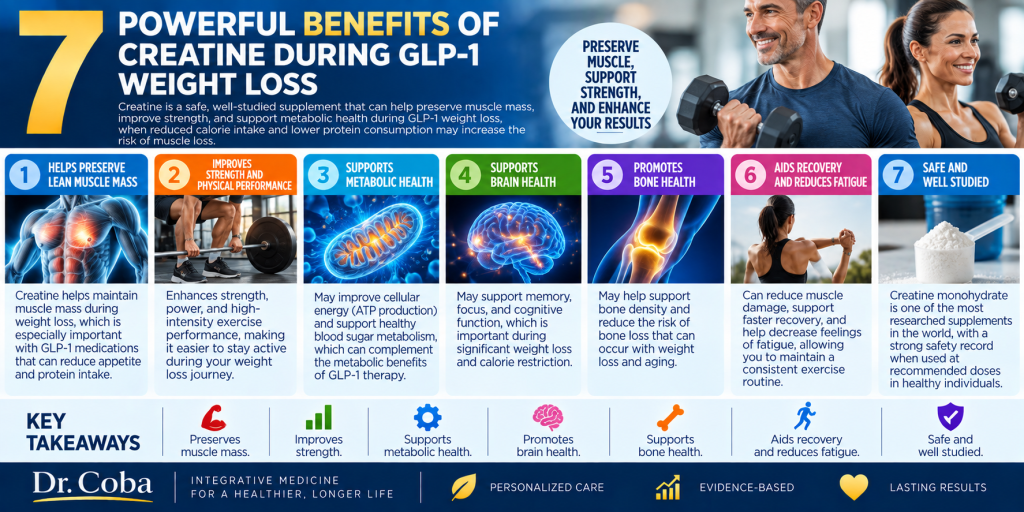
1. Supports Strength During Resistance Training
Strength is an important marker of skeletal muscle function. During substantial weight reduction, maintaining strength can help patients continue exercising effectively and preserve their ability to perform normal daily activities.
Creatine increases intramuscular phosphocreatine availability. This stored phosphocreatine can rapidly donate a phosphate group to adenosine diphosphate (ADP), helping regenerate ATP during brief periods of high muscular demand.
This energy-buffering system becomes particularly relevant during resistance exercise, where repeated sets of muscular contractions require rapid ATP regeneration.
When creatine supplementation improves the ability to perform slightly more repetitions, maintain training intensity, or recover between repeated efforts, it may indirectly support the progressive training stimulus needed to preserve muscular strength.
This does not mean that creatine alone builds or preserves muscle without exercise. Resistance training remains the primary mechanical stimulus, while adequate protein and overall nutrition provide the substrates required for recovery and adaptation.
For patients who are physically able to perform resistance exercise, creatine during GLP-1 weight loss may therefore serve as an adjunct to a structured muscle-preservation strategy rather than as a substitute for training.
2. May Help Support Lean Muscle During Weight Loss
Creatine during GLP-1 weight loss is particularly relevant because weight loss does not come exclusively from adipose tissue. During a sustained energy deficit, some fat-free mass can also be lost, particularly when calorie restriction is substantial or when resistance exercise and protein intake are inadequate.
Creatine can increase intramuscular creatine stores and, when combined with resistance training, has been associated with improvements in strength and lean body mass in a variety of populations.
Part of the early increase in lean mass associated with creatine reflects greater water content within skeletal muscle. This intracellular water retention should not be confused with an increase in body fat.
Over longer periods, creatine may also help patients train more effectively. Greater training capacity can provide skeletal muscle with a stronger and more consistent mechanical stimulus, which is particularly valuable during an energy deficit.
The most important point is that creatine should be integrated into a broader strategy. Adequate dietary protein, progressive resistance training, appropriate calorie restriction, and recovery remain fundamental components of muscle preservation.
Therefore, creatine during GLP-1 weight loss may help support lean tissue indirectly by improving the training environment in which muscle is challenged and maintained.
3. May Improve Training Capacity and Exercise Performance
Preserving muscle with creatine during GLP-1 weight loss requires more than supplementation alone and should include appropriately designed resistance exercise. The muscles must receive a sufficient and progressively challenging training stimulus over time.
Creatine supplementation can increase phosphocreatine availability within skeletal muscle, supporting rapid ATP regeneration during repeated bouts of high-intensity activity. This may allow some individuals to perform additional repetitions, maintain resistance across sets, or sustain training quality more effectively.
Small improvements in individual workouts may become meaningful when accumulated over weeks and months. Greater training volume or intensity can provide a stronger stimulus for maintaining muscular strength and supporting adaptation.
This may be particularly relevant when reduced calorie intake contributes to fatigue or when patients are beginning a structured resistance-training program while simultaneously losing substantial body weight.
Creatine should not be expected to compensate for inadequate sleep, poor nutrition, dehydration, excessive calorie restriction, or an inappropriate exercise program. These factors still influence recovery and performance.
When incorporated into an appropriate training and nutrition plan, creatine during GLP-1 weight loss may help patients maintain the exercise capacity needed to continue challenging skeletal muscle as body weight decreases.
4. May Be Particularly Useful for Older Adults
Creatine during GLP-1 weight loss may be particularly relevant for older adults because aging is commonly associated with progressive reductions in skeletal muscle mass, strength, and physical performance.
When appetite and calorie intake decline during GLP-1 therapy, preserving functional muscle becomes increasingly important. Lower muscle reserves may leave some older adults more vulnerable to weakness, impaired mobility, and loss of physical independence if lean tissue declines substantially.
Research in older adults suggests that creatine supplementation combined with resistance training can enhance some improvements in muscular strength and lean tissue compared with resistance training alone. However, results vary among studies, and creatine should be considered an adjunct rather than a replacement for exercise and adequate nutrition.
Resistance training remains central because skeletal muscle requires a mechanical stimulus to maintain and improve function. Adequate dietary protein, total nutrition, hydration, and recovery are also important components of the strategy.
Older patients should additionally be evaluated for factors such as frailty, balance impairment, orthopedic limitations, kidney disease, medication use, and baseline exercise capacity when designing a supplementation and training program.
For appropriately selected older adults, creatine during GLP-1 weight loss may complement resistance exercise as part of a broader strategy aimed at preserving strength, mobility, skeletal muscle, and long-term physical independence.
5. Supports the Energy System Used During High-Intensity Exercise
Skeletal muscle requires ATP to produce force, but the amount of ATP stored directly within muscle is limited. During brief periods of intense muscular activity, the phosphocreatine system helps regenerate ATP rapidly.
Creatine supplementation increases muscle creatine and phosphocreatine stores, expanding the readily available substrate for this rapid energy system. This is one reason creatine has been extensively studied for resistance training, sprinting, and other repeated high-intensity activities.
For patients performing resistance exercise, greater phosphocreatine availability may help maintain muscular performance across repeated sets. Over time, maintaining training quality can contribute to a more effective strength and muscle-preservation program.
This mechanism differs from stimulants. Creatine does not need to produce a sensation of increased energy or alertness to be effective. Its primary role is within cellular energy metabolism rather than central nervous system stimulation.
Patients should still consume adequate calories and nutrients for their individual circumstances. Creatine cannot compensate for severe undernutrition, dehydration, inadequate protein intake, or insufficient recovery.
Used appropriately, creatine during GLP-1 weight loss may support the cellular energy demands of resistance exercise while patients work to preserve muscle and strength during a calorie deficit.
6. May Help Maintain Training Quality During a Calorie Deficit
During creatine during GLP-1 weight loss, a sustained calorie deficit can reduce body fat but may also affect exercise performance, recovery, and the ability to maintain previous training workloads.
This becomes especially relevant when GLP-1 therapy markedly suppresses appetite. Some patients may unintentionally reduce calories beyond what is necessary, while also consuming less protein, carbohydrate, fluid, and other nutrients needed to support exercise.
Creatine cannot replace adequate nutrition, but its role in rapid ATP regeneration may help support repeated high-intensity muscular efforts during resistance training.
Maintaining training quality matters because skeletal muscle responds to the mechanical demands placed upon it. If resistance, repetitions, or overall training volume progressively decline during weight loss, the stimulus for maintaining strength and muscle may also decrease.
Patients should therefore monitor training performance together with body weight. Persistent reductions in strength, excessive fatigue, dizziness, poor recovery, or declining physical function may indicate that the overall weight-loss and exercise strategy requires reassessment.
When adequate nutrition and recovery are maintained, creatine during GLP-1 weight loss may help support the training quality needed to preserve muscular strength and function during an energy deficit.
7. May Support Long-Term Muscle Preservation When Combined With Training
The potential value of creatine during GLP-1 weight loss is best understood over time rather than as an immediate or isolated effect. Preserving muscle during substantial weight loss requires repeated resistance-training sessions, adequate nutrition, and consistent recovery over many weeks and months.
Creatine may help support this process by improving the capacity to perform repeated high-intensity muscular work. Even relatively small improvements in training performance can accumulate when they allow patients to maintain resistance, repetitions, or training volume consistently.
Long-term muscle preservation is especially relevant after the initial weight-loss phase. Once a patient reaches a lower body weight, maintaining strength and skeletal muscle can support physical activity, metabolic health, mobility, and weight-management efforts.
Creatine should therefore be viewed as one component of a larger muscle-preservation strategy rather than as a stand-alone intervention. Progressive resistance training remains essential, while adequate protein and overall nutritional intake provide the building blocks required for recovery and adaptation.
The appropriate strategy may also change as body weight, fitness, medication dose, appetite, and nutritional intake evolve. Monitoring strength and physical performance can help determine whether the overall program remains effective.
When combined with consistent resistance exercise and appropriate nutrition, creatine during GLP-1 weight loss may contribute to a long-term strategy focused not simply on losing weight, but on preserving the strength and functional muscle needed for healthy aging.
How Much Creatine Should You Take During GLP-1 Weight Loss?
For most adults who choose to supplement, creatine monohydrate is the form with the strongest research base. More expensive forms of creatine have not consistently demonstrated superior results.
A commonly studied maintenance dose is 3–5 grams of creatine monohydrate per day. Consistent daily intake gradually increases skeletal-muscle creatine stores, so creatine does not need to be taken only on resistance-training days.
A loading phase is optional. Traditional loading protocols often use approximately 20 grams per day divided into four 5-gram doses for 5–7 days, followed by a maintenance dose. However, taking 3–5 grams daily without loading can also increase muscle creatine stores over time and may be simpler and better tolerated.
Timing is generally less important than consistency. Creatine can be taken with a meal, protein shake, or another convenient beverage. Patients do not need to precisely time supplementation immediately before or after exercise to obtain its potential benefits.
Some people notice a modest increase in body weight after beginning creatine because additional creatine stored in skeletal muscle is accompanied by intracellular water. This is not the same as gaining body fat and should be considered when interpreting short-term changes on the scale.
Patients with known kidney disease, significant renal impairment, complex medical conditions, or uncertainty about supplementation should discuss creatine with their treating clinician before starting it.
For appropriately selected adults, a simple daily creatine-monohydrate regimen can make creatine during GLP-1 weight loss practical without unnecessarily complicated dosing protocols.
Is Creatine Safe During GLP-1 Therapy?
Creatine during GLP-1 weight loss should be considered in the context of the broader safety evidence showing that creatine monohydrate is generally well tolerated in healthy adults when used at recommended doses. However, supplementation should still be considered within the context of the individual’s medical history, medications, hydration status, and kidney function.
One important clinical consideration is serum creatinine. Creatine can be converted to creatinine, so supplementation may cause a modest increase in measured serum creatinine in some individuals. This does not automatically indicate kidney injury, because creatinine is also influenced by muscle mass, diet, and creatine intake.
When kidney function needs closer assessment, clinicians may interpret creatinine-based estimated glomerular filtration rate in the context of supplementation and other clinical information. In selected situations, alternative markers such as cystatin C may provide additional information.
Hydration also deserves attention during GLP-1 treatment. Nausea, vomiting, diarrhea, reduced appetite, or reduced fluid intake can increase the risk of dehydration in some patients. Creatine should not be used as a substitute for adequate fluid intake.
Patients with known chronic kidney disease, significant renal impairment, recurrent dehydration, or complex medical conditions should discuss supplementation with their treating clinician before beginning creatine. Individual assessment is preferable to assuming that the same recommendation applies to everyone.
For appropriately selected patients, creatine during GLP-1 weight loss can be considered within a broader program that includes adequate hydration, appropriate nutrition, resistance training, and clinical monitoring when indicated.
The Bottom Line on Creatine During GLP-1 Weight Loss
GLP-1-based medications can be highly effective for reducing body weight, but successful treatment should consider the quality of that weight loss as well as the number of pounds lost. Preserving skeletal muscle, strength, and physical function is an important part of that objective.
Creatine monohydrate is one of the most extensively studied nutritional supplements for supporting high-intensity exercise and resistance-training performance. Its ability to increase skeletal-muscle creatine stores can help support rapid ATP regeneration during repeated muscular efforts.
However, creatine should not be viewed as a stand-alone solution for preventing muscle loss. Progressive resistance training remains the primary mechanical stimulus, while adequate protein, appropriate nutrition, hydration, sleep, and recovery provide the environment needed for muscular adaptation.
A daily dose of approximately 3–5 grams of creatine monohydrate is commonly used in research and clinical practice. A loading phase is optional, and consistent daily supplementation is generally more important than precise timing.
Older adults may be particularly interested in strategies that preserve strength and functional muscle during substantial weight reduction, although individual health status, kidney function, medications, exercise capacity, and nutritional intake should be considered.
Importantly, direct clinical evidence specifically testing creatine supplementation in patients receiving GLP-1 medications remains limited. Recommendations should therefore distinguish the established evidence for creatine and resistance training from conclusions specifically proven in GLP-1-treated populations.
Ultimately, creatine during GLP-1 weight loss may be a useful adjunct for appropriately selected patients when it is incorporated into a comprehensive muscle-preservation strategy rather than used in isolation.
Pingback: Protein Intake During GLP-1 Weight Loss: 7 Proven Tips