
Understanding GLP-1 Muscle Loss During Weight Reduction
GLP-1 receptor agonists such as semaglutide and dual GIP/GLP-1 medications such as tirzepatide have transformed medical weight management. These medications can produce substantial reductions in body weight and improve several markers of metabolic health in appropriately selected patients.
However, weight loss does not consist exclusively of body fat. During significant weight reduction, some fat-free or lean mass can also be lost. This has raised important questions about GLP-1 muscle loss, particularly in older adults, patients with low baseline muscle mass, and individuals losing weight rapidly.
Lean mass and skeletal muscle are not identical. Measurements such as DXA may classify water, organs, connective tissue, and skeletal muscle within fat-free or lean compartments. Therefore, a reported reduction in lean mass during a clinical trial should not automatically be interpreted as an equivalent amount of skeletal muscle loss.
Nevertheless, preserving skeletal muscle remains clinically important. Muscle supports strength, mobility, glucose disposal, metabolic health, physical function, and independence as people age.
The objective of medical weight management should therefore extend beyond achieving the lowest possible number on the scale. A well-designed strategy should aim to reduce excess adiposity while maintaining adequate nutrition, skeletal muscle, strength, and physical function.
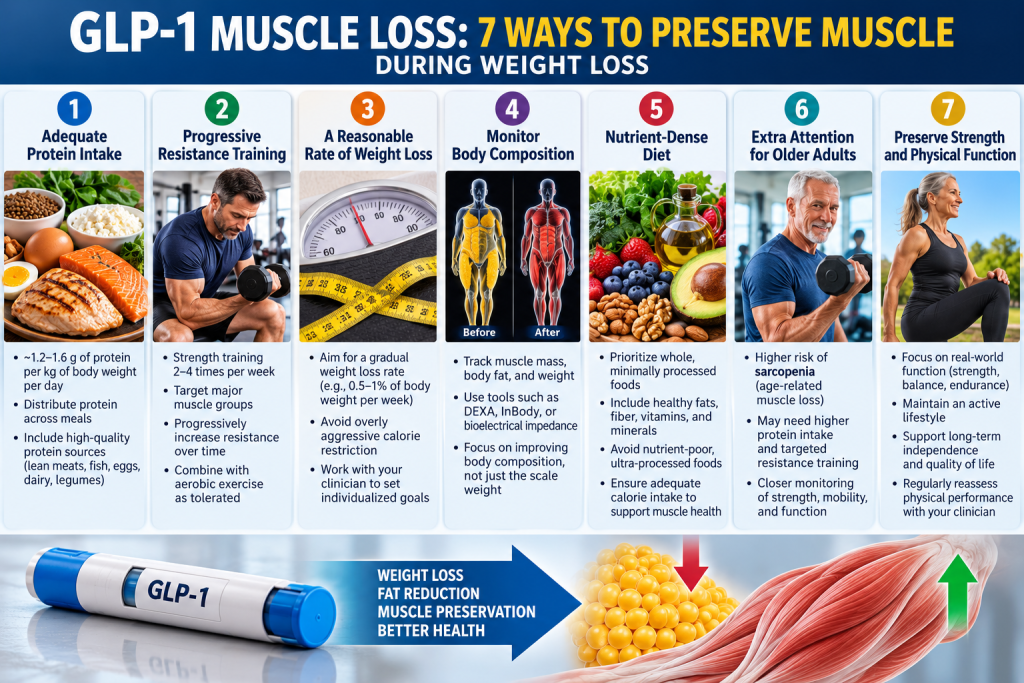
Fortunately, several modifiable factors—including adequate protein intake, progressive resistance training, an appropriate rate of weight loss, and monitoring of body composition and physical performance—can help support muscle preservation during treatment.
7 Powerful Ways to Reduce GLP-1 Muscle Loss
1. Prioritize Adequate Protein Intake
Adequate protein intake is one of the most important nutritional strategies for preserving skeletal muscle during weight loss.
When appetite decreases substantially during treatment with semaglutide, tirzepatide, or other incretin-based medications, total food intake often falls. If protein intake falls too far at the same time, the body may have less dietary amino acid available to support muscle protein synthesis.
Protein needs should be individualized according to age, body size, kidney function, physical activity, baseline muscle mass, and overall nutritional status. Older adults and individuals performing resistance training may require particular attention to protein quantity and distribution throughout the day.
Rather than consuming most daily protein in a single meal, spreading high-quality protein across multiple meals may help support repeated stimulation of muscle protein synthesis.
For patients concerned about GLP-1 muscle loss, preserving adequate protein intake should therefore be considered a core component of the weight-management plan rather than an afterthought.
2. Make Resistance Training a Priority
Resistance training provides one of the strongest physiological signals for maintaining skeletal muscle during weight reduction. When energy intake decreases, muscles need an adequate training stimulus to help preserve strength and lean tissue.

Exercises can include free weights, resistance machines, resistance bands, or appropriately designed body-weight movements. The specific program should reflect the patient’s age, baseline strength, mobility, orthopedic limitations, cardiovascular status, and previous training experience.
Progressive overload is particularly important. As strength and exercise tolerance improve, resistance should gradually increase so that the muscles continue receiving an appropriate stimulus.
Aerobic activity remains valuable for cardiovascular fitness, insulin sensitivity, and overall health. However, aerobic exercise alone should not replace resistance training when preservation of skeletal muscle is a primary objective.
For patients experiencing substantial weight reduction, combining adequate protein with progressive resistance exercise provides a practical foundation for reducing the risk of GLP-1 muscle loss while supporting strength and physical function.
3. Avoid Excessively Rapid Weight Loss
The rate of weight reduction may influence GLP-1 muscle loss and how well lean tissue is preserved. A larger or more aggressive energy deficit can increase the likelihood that weight loss includes not only body fat but also fat-free mass.
GLP-1-based medications can markedly reduce appetite in some patients. As a result, caloric intake may unintentionally fall to very low levels, particularly during dose escalation or when gastrointestinal adverse effects interfere with normal eating.
The goal should not necessarily be to lose weight as rapidly as possible. A clinically appropriate rate of weight reduction should allow sufficient intake of protein, essential nutrients, and fluids while maintaining the patient’s ability to exercise and perform normal daily activities.
Unexpected weakness, declining exercise performance, persistent fatigue, inadequate food intake, or rapid reductions in body weight may warrant reassessment of nutrition, training, medication tolerance, and the overall treatment plan.
Reducing GLP-1 muscle loss therefore requires attention not only to how much weight is lost, but also to the rate and quality of that weight reduction.
4. Monitor Body Composition, Not Just Body Weight
A conventional scale shows how much total body weight has changed, but it cannot determine whether that change came primarily from fat, lean tissue, water, or a combination of these compartments.
Body-composition assessment can therefore provide useful information during substantial weight reduction. Methods such as DXA, bioelectrical impedance analysis, and other validated techniques can help estimate changes in fat mass and lean mass over time.
These measurements also have limitations. Lean mass is not synonymous with skeletal muscle, and hydration status can influence some body-composition measurements. For this reason, results should be interpreted together with clinical findings rather than viewed in isolation.
Waist circumference can provide additional information about changes in abdominal adiposity, while measurements of strength and physical performance can help determine whether functional capacity is being maintained.
For patients at greater risk of GLP-1 muscle loss, tracking body composition together with strength, nutritional intake, and physical function provides a more meaningful assessment than relying exclusively on pounds lost.
5. Protect Muscle With Adequate Calories and Nutrient-Dense Foods
GLP-1 muscle loss may become a greater concern when appetite suppression makes it difficult for patients to consume enough food to support optimal nutrition. Simply eating less is not the same as eating well.
When total food intake decreases, nutrient density becomes increasingly important. Meals should prioritize high-quality protein, vegetables, fruits, healthy fats, and other nutrient-rich foods rather than allowing a limited appetite to be filled primarily with low-protein or highly processed foods.
Extremely low calorie intake may make it more difficult to obtain adequate protein, essential fatty acids, vitamins, minerals, and other nutrients needed to support muscle function, recovery, and overall health.
Patients experiencing persistent nausea, excessive appetite suppression, difficulty meeting protein requirements, dehydration, or inability to consume adequate nutrition should have their treatment strategy reassessed rather than simply accepting these problems as evidence that the medication is working.
Preventing GLP-1 muscle loss therefore requires maintaining sufficient nutritional quality and intake to support skeletal muscle while still creating an appropriate energy deficit for fat reduction.
6. Pay Special Attention to Older Adults and Patients With Low Muscle Mass
Not every patient begins weight-loss treatment with the same amount of skeletal muscle or the same physiological reserve. Older adults, sedentary individuals, and patients with pre-existing low muscle mass may require additional attention during substantial weight reduction.
Age-related loss of muscle mass and strength can progress gradually over time. When obesity and low muscle mass occur together, the combination may impair mobility, metabolic health, and physical function even when body weight remains elevated.
For these patients, aggressive weight reduction without adequate protein intake and resistance exercise may be counterproductive if clinically important amounts of muscle and strength are lost along with body fat.
Assessment may therefore include baseline body composition, dietary protein intake, physical activity, grip strength or other functional measures, and the patient’s ability to perform resistance exercise safely.
Preventing GLP-1 muscle loss is particularly important in patients vulnerable to sarcopenia because the objective should be improved body composition and metabolic health while maintaining strength, mobility, and independence.
7. Track Strength and Physical Function Along With Muscle Mass
Preserving muscle during weight loss is not solely about maintaining a particular lean-mass measurement. The ability of skeletal muscle to generate strength and support normal physical function is equally important.
Simple functional measures can provide valuable information over time. Depending on the patient, these may include grip strength, walking speed, chair-rise performance, resistance-training performance, balance, or the ability to perform routine activities without increasing difficulty.
A patient may lose some measured lean mass while maintaining or even improving strength and physical performance. Conversely, declining strength, reduced exercise capacity, or increasing difficulty with daily activities may signal a clinically important problem even when body-composition changes appear modest.
Resistance-training progression can also serve as a practical indicator. Maintaining or gradually improving training performance during weight reduction suggests that the patient’s exercise program and nutritional strategy are supporting functional muscle.
When addressing GLP-1 muscle loss, the goal should therefore be preservation of both skeletal muscle and what that muscle allows the patient to do—maintaining strength, mobility, metabolic function, and long-term independence.
GLP-1 Medications, Muscle Loss, and Sarcopenia Are Not the Same Thing
The terms muscle loss and sarcopenia are sometimes used interchangeably, but they do not describe exactly the same condition.
Sarcopenia is a clinically important disorder characterized primarily by reduced muscle strength together with abnormalities in muscle quantity or quality, with physical performance helping determine severity. It is particularly relevant in older adults, although low muscle mass and impaired muscle function can occur at other ages.
A reduction in lean mass measured during weight loss does not automatically mean that a patient has developed sarcopenia. Lean mass measurements include tissues other than skeletal muscle, and changes in hydration can also affect some body-composition measurements.
The clinical concern becomes greater when declining muscle quantity is accompanied by reduced strength, slower walking, difficulty rising from a chair, impaired balance, reduced exercise capacity, or loss of independence.
This distinction is important when discussing GLP-1 muscle loss. The objective is not necessarily to prevent every measurable change in lean mass, but to preserve clinically meaningful skeletal muscle, strength, and physical performance while excess body fat is reduced.
Who May Be at Greater Risk of Muscle Loss During GLP-1 Treatment?
The risk of losing clinically meaningful muscle during weight reduction is not identical for every patient. Baseline muscle mass, age, nutritional status, physical activity, medical conditions, and the magnitude and rate of weight loss can all influence risk.
Older adults deserve particular attention because aging is commonly accompanied by progressive reductions in muscle mass, strength, and anabolic responsiveness. Patients who are sedentary or already have low muscle mass may also have less physiological reserve before weight-loss treatment begins.
Other potential concerns include very rapid weight loss, severe appetite suppression, chronically inadequate protein intake, prolonged inactivity, recurrent gastrointestinal symptoms that limit food intake, and medical conditions associated with malnutrition or muscle wasting.
Patients who cannot perform resistance exercise because of orthopedic, neurologic, cardiovascular, or functional limitations may require an especially individualized strategy to maintain muscle and physical capacity.
For patients at increased risk of GLP-1 muscle loss, baseline assessment and periodic monitoring of nutrition, body composition, strength, and physical function can help identify unfavorable changes early enough to modify the treatment plan.
What Should Be Monitored to Protect Muscle During GLP-1 Weight Loss?
Monitoring during GLP-1-based weight management should extend beyond body weight and BMI. A lower number on the scale does not reveal whether the patient is primarily losing excess fat or also experiencing clinically important deterioration in muscle and physical function.
Body weight and waist circumference remain useful, but body-composition assessment can provide additional information about changes in fat mass and lean tissue. When possible, measurements should be performed under reasonably consistent conditions to improve comparability over time.
Nutritional intake should also be reviewed. Persistent difficulty consuming adequate protein, very low overall calorie intake, dehydration, or recurrent gastrointestinal symptoms may indicate that the treatment strategy needs adjustment.
Strength and physical performance provide another important layer of information. Skeletal muscle also plays an important role in glucose disposal and blood sugar regulation, making muscle preservation relevant to metabolic health as well as physical function. Resistance-training performance, grip strength, chair-rise ability, walking speed, mobility, and the ability to perform normal daily activities can help determine whether functional capacity is being maintained.
For patients concerned about GLP-1 muscle loss, the most useful monitoring strategy therefore combines changes in body composition with protein and nutritional intake, resistance exercise, strength, and physical function rather than relying on body weight alone.
The Bottom Line on GLP-1 Muscle Loss
GLP-1-based medications can produce substantial weight reduction and meaningful improvements in metabolic health, but successful treatment should not be judged solely by how many pounds are lost.
Some reduction in lean mass can accompany significant weight loss, and lean mass is not synonymous with skeletal muscle. The clinically important objective is to reduce excess adiposity while preserving muscle, strength, nutritional status, mobility, and physical function.
Adequate protein intake and progressive resistance training form the foundation of a muscle-preservation strategy. Appropriate calorie intake, nutrient-dense foods, a reasonable rate of weight reduction, and monitoring of body composition and physical performance provide additional protection.
Older adults and patients who already have low muscle mass deserve particular attention because they may have less physiological reserve and greater consequences from excessive muscle or strength loss.
Ultimately, addressing GLP-1 muscle loss requires shifting the goal from simple weight reduction to improved body composition. The most successful strategy is one that reduces excess body fat while helping the patient remain metabolically healthy, physically strong, and functionally independent.
Pingback: Protein Intake During GLP-1 Weight Loss: 7 Proven Tips