
Understanding Low Testosterone and Prostate Health
Low testosterone and prostate health are closely connected because testosterone and other androgens influence normal prostate biology throughout adult life. However, the relationship between testosterone levels, prostate enlargement, urinary symptoms, prostate-specific antigen (PSA), and prostate cancer is more complex than the traditional idea that higher testosterone simply causes prostate disease.
As men age, testosterone levels may decline while benign prostate enlargement and urinary symptoms become more common. These conditions can therefore occur at the same time without one necessarily being the direct cause of the other.
The relationship becomes particularly important when testosterone replacement therapy is being considered. Men with confirmed testosterone deficiency may benefit from treatment when clinically appropriate, but prostate history, urinary symptoms, PSA results, age, and individual risk factors should be considered as part of the evaluation.
Understanding low testosterone and prostate health therefore requires looking beyond a single testosterone or PSA measurement. The goal is to identify true hormonal deficiency while appropriately evaluating prostate symptoms and findings that may require further assessment.
7 Important Connections Between Low Testosterone and Prostate Health
1. Testosterone Plays a Role in Normal Prostate Biology
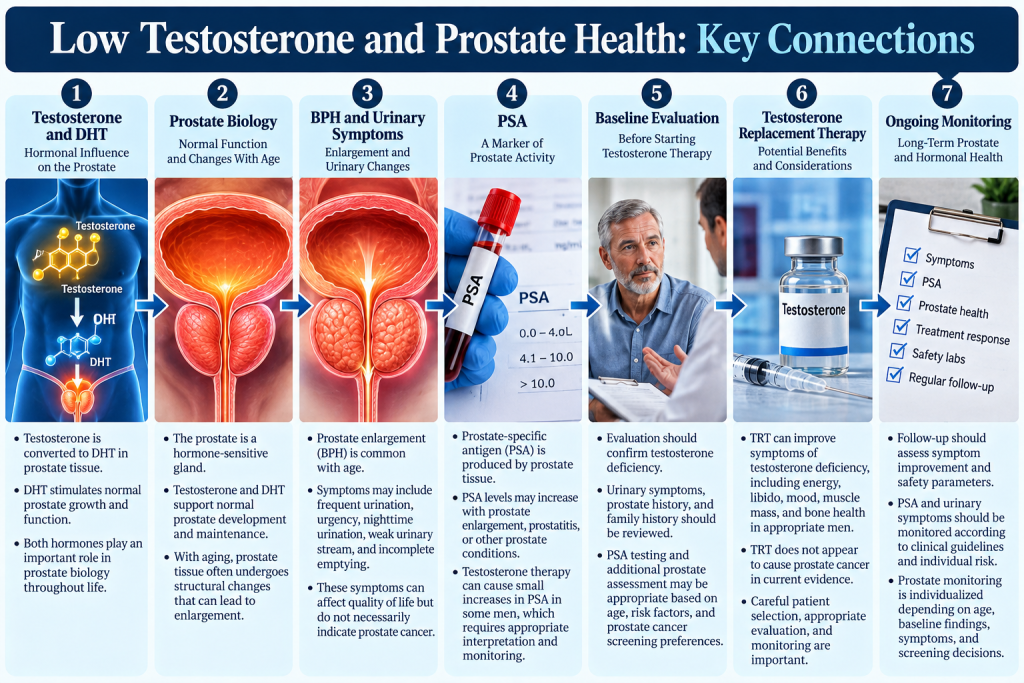
The prostate is an androgen-responsive organ. Testosterone circulating in the bloodstream can enter prostate tissue, where some of it is converted by the enzyme 5-alpha-reductase into dihydrotestosterone (DHT), a more potent androgen within the prostate.
Androgen signaling is important for normal prostate development and function. However, this does not mean that progressively higher testosterone levels necessarily produce progressively greater prostate growth or disease.
Prostate biology is influenced by multiple factors, including age, genetics, inflammation, metabolic health, androgen receptor activity, and local hormone metabolism. This helps explain why men with similar testosterone levels can have very different prostate sizes, PSA levels, and urinary symptoms.
When considering low testosterone and prostate health, testosterone should therefore be viewed as one component of a much broader biological system rather than as the sole determinant of prostate disease.
2. Low Testosterone and BPH Can Occur at the Same Time
Benign prostatic hyperplasia (BPH) becomes increasingly common as men age. Testosterone levels, meanwhile, often decline gradually with aging, which means prostate enlargement and low testosterone frequently coexist.
This age-related overlap does not establish that low testosterone causes BPH or that restoring testosterone necessarily causes clinically significant prostate enlargement. Prostate growth is influenced by multiple hormonal and nonhormonal factors.
BPH can contribute to lower urinary tract symptoms such as urinary frequency, urgency, nighttime urination, a weak urinary stream, hesitancy, and incomplete bladder emptying. These symptoms should be evaluated on their own merits rather than assumed to result from testosterone levels.
For men with low testosterone and prostate health concerns, identifying significant urinary symptoms before considering testosterone therapy helps establish a baseline and determine whether additional prostate or urinary evaluation is appropriate.
3. PSA Levels May Change With Testosterone Therapy
Prostate-specific antigen (PSA) is produced by prostate tissue and is commonly used as one component of prostate evaluation. PSA is not specific for prostate cancer and may also be influenced by benign prostate enlargement, inflammation, infection, age, and other factors.
Because prostate tissue is androgen responsive, PSA levels may change after testosterone replacement therapy begins. A modest increase does not automatically indicate prostate cancer, but the pattern and magnitude of change may require clinical interpretation.
Obtaining an appropriate baseline prostate assessment before initiating testosterone therapy can make subsequent PSA results easier to interpret. Follow-up should then be individualized according to age, baseline findings, symptoms, risk factors, and current clinical guidelines.
When low testosterone and prostate health are evaluated together, PSA should therefore be interpreted within the complete clinical picture rather than treated as an isolated diagnostic result.
4. Testosterone Therapy Does Not Automatically Mean Prostate Cancer
For many years, testosterone therapy was approached with substantial concern that increasing testosterone could stimulate the development of prostate cancer. The relationship is now understood to be more complex than a simple “more testosterone equals more cancer” model.
Current evidence has not established that appropriately prescribed testosterone replacement therapy causes prostate cancer in men without known disease. However, this does not mean that prostate evaluation and monitoring are unnecessary.
Prostate cancer is common with advancing age, and some men considering testosterone therapy may have an elevated PSA, abnormal prostate findings, or previously undiagnosed disease that requires further evaluation before treatment decisions are made.
When discussing low testosterone and prostate health, the important distinction is between causing prostate cancer and potentially influencing androgen-sensitive prostate tissue. Appropriate baseline assessment and follow-up remain important components of responsible testosterone therapy.
5. Urinary Symptoms Should Be Evaluated Before TRT
Lower urinary tract symptoms are common in aging men and may include urinary frequency, urgency, nighttime urination, hesitancy, weak urinary flow, and a sensation of incomplete bladder emptying.
These symptoms are often associated with benign prostate enlargement, but other urinary and neurological conditions can produce similar complaints. Their presence does not necessarily mean that testosterone therapy is inappropriate.
However, significant or worsening urinary symptoms deserve evaluation before treatment. Establishing the severity and possible cause of symptoms provides a useful baseline and helps identify men who may benefit from additional urologic assessment.
For men with low testosterone and prostate health concerns, testosterone therapy should therefore be considered within the broader context of urinary function, prostate findings, PSA when appropriate, and the individual patient’s clinical history.
6. Baseline Prostate Assessment Helps Guide Testosterone Therapy
Before starting testosterone replacement therapy, prostate assessment may be appropriate depending on a man’s age, symptoms, medical history, individual risk factors, and preferences regarding prostate cancer screening.
A baseline PSA can provide a reference point for future comparison when testing is clinically appropriate. Urinary symptoms, previous PSA results, prostate history, medications, family history, and prior urologic evaluations may also influence the assessment.
An elevated PSA does not by itself diagnose prostate cancer. PSA results require interpretation in context, and abnormal findings may warrant repeat testing or additional evaluation before testosterone therapy is initiated.
For men with low testosterone and prostate health concerns, establishing an appropriate baseline helps clinicians distinguish pre-existing prostate findings from changes that may occur during subsequent treatment and monitoring.
7. Prostate Monitoring Remains Important During TRT
Follow-up after starting testosterone replacement therapy is important because treatment can affect several clinical and laboratory parameters. Prostate monitoring should be individualized according to age, baseline findings, symptoms, risk factors, and shared decisions regarding prostate cancer screening.
Changes in PSA should be interpreted in context rather than assumed to represent cancer. Benign prostate enlargement, inflammation, infection, recent urinary procedures, and other factors can influence PSA levels.
New or worsening urinary symptoms, an unexpected PSA change, or abnormal prostate findings may require additional evaluation. In some circumstances, consultation with a urologist may be appropriate before continuing or modifying testosterone therapy.
For men with low testosterone and prostate health concerns, ongoing monitoring allows testosterone treatment to be integrated with appropriate prostate surveillance rather than treating hormonal and urologic health as unrelated issues.
How to Evaluate Low Testosterone and Prostate Health
Evaluation should determine whether testosterone deficiency is truly present while also identifying prostate or urinary findings that may influence treatment decisions.
A detailed history may include symptoms of testosterone deficiency, urinary frequency, urgency, nighttime urination, weak urinary stream, difficulty emptying the bladder, previous prostate problems, medications, family history, and prior PSA results or urologic evaluations.
When testosterone deficiency is suspected, appropriately timed testosterone measurements are important. A low testosterone result generally requires confirmation, while additional hormonal testing may be appropriate depending on the clinical circumstances.
Prostate evaluation should be individualized according to age, symptoms, medical history, risk factors, and preferences regarding prostate cancer screening. PSA testing and additional assessment may be appropriate for some men before testosterone therapy is initiated.
The purpose of evaluating low testosterone and prostate health together is to establish an accurate hormonal diagnosis while identifying prostate findings that may require monitoring, further testing, or urologic evaluation.
How to Protect Prostate Health When Testosterone Is Low
Protecting prostate health begins with recognizing that testosterone deficiency and prostate disease are separate clinical issues that may coexist. Treating low testosterone does not eliminate the need to evaluate urinary symptoms, PSA changes, or other prostate concerns when clinically appropriate.
Men should report new or worsening urinary symptoms such as difficulty initiating urination, weak urinary flow, increased nighttime urination, urgency, or incomplete bladder emptying. These symptoms may reflect benign prostate enlargement or other urinary conditions that deserve evaluation.
Healthy body weight, regular physical activity, appropriate management of diabetes and metabolic disease, avoidance of smoking, and a nutrient-dense diet support overall health and may also contribute to better urinary and metabolic function.
For men receiving testosterone replacement therapy, follow-up should include assessment of treatment response and safety parameters while prostate monitoring is individualized according to age, baseline findings, symptoms, and prostate cancer screening decisions.
The objective when managing low testosterone and prostate health is not simply to normalize a laboratory value. It is to improve appropriate symptoms while maintaining careful attention to prostate and urinary health over time.
The Bottom Line on Low Testosterone and Prostate Health
Low testosterone and prostate health have an important but complex relationship. Testosterone and DHT participate in normal prostate biology, yet prostate enlargement, urinary symptoms, PSA changes, and prostate cancer cannot be explained by testosterone levels alone.
Men with testosterone deficiency may also develop BPH or other prostate conditions as they age. The presence of one does not necessarily mean that it caused the other.
Before testosterone replacement therapy is initiated, appropriate evaluation should confirm testosterone deficiency while considering urinary symptoms, prostate history, PSA when clinically appropriate, and individual prostate cancer risk factors.
For men receiving testosterone therapy, changes in PSA or urinary symptoms should be interpreted within the complete clinical picture rather than automatically attributed to treatment or cancer.
A comprehensive approach to low testosterone and prostate health combines accurate hormonal diagnosis, individualized prostate assessment, appropriate monitoring, and attention to the patient’s overall metabolic and urologic health.