
Understanding Low Testosterone and Bone Health
Low testosterone and bone health are closely connected because sex hormones play an important role in maintaining the strength and structure of the male skeleton. Men with persistent testosterone deficiency may experience progressive loss of bone mineral density, particularly when the deficiency is severe or prolonged.
Bone loss usually develops silently. Unlike fatigue, reduced libido, or changes in muscle mass, declining bone density may produce no obvious symptoms until osteoporosis or a fracture occurs.
Testosterone affects bone both directly and indirectly. Some testosterone is converted to estradiol, and estradiol is particularly important for regulating bone remodeling and limiting excessive bone resorption in men.
For this reason, persistent testosterone deficiency should be considered within a broader assessment of skeletal health that includes age, fracture history, medications, nutrition, vitamin D status, physical activity, smoking and alcohol exposure, and other conditions that may contribute to osteoporosis.
7 Important Connections Between Low Testosterone and Bone Health
1. Testosterone Helps Maintain Bone Mineral Density
Bone is a dynamic tissue that continuously undergoes remodeling through the coordinated activity of bone-forming osteoblasts and bone-resorbing osteoclasts. Sex hormones help regulate this balance throughout adult life.
Testosterone supports skeletal health through several mechanisms, including effects on muscle mass, physical activity, and bone formation. In addition, a portion of testosterone is converted by aromatase into estradiol, which plays a major role in limiting excessive bone resorption in men.
When testosterone deficiency persists, this hormonal support may decline and bone mineral density can gradually decrease. The effect may be especially important in men with profound or long-standing hypogonadism.
Because bone loss may occur without pain or other obvious warning signs, men with testosterone deficiency can develop reduced skeletal strength before realizing that their bone health has changed.
2. Testosterone Deficiency Can Increase Osteoporosis Risk
Osteoporosis is characterized by reduced bone strength and an increased susceptibility to fractures. Although it is often associated with women after menopause, osteoporosis is also an important health concern in men, particularly as they age.
Hypogonadism is a recognized secondary cause of osteoporosis in men. When testosterone deficiency persists, changes in sex-hormone signaling can accelerate bone loss and contribute to reduced bone mineral density.
The risk becomes more important when other factors are present, including advanced age, low body weight, smoking, excessive alcohol intake, prolonged glucocorticoid use, vitamin D deficiency, limited physical activity, or a previous fragility fracture.
When low testosterone and bone health concerns occur together, identifying these additional risk factors can help determine whether further skeletal evaluation, including bone-density testing when appropriate, should be considered.
3. Estradiol Is Also Critical for Bone Health in Men
Although testosterone receives much of the attention in male hormonal health, estradiol also plays a crucial role in maintaining the male skeleton. Men produce estradiol primarily through the conversion of testosterone by the aromatase enzyme.
Estradiol helps regulate bone remodeling by limiting excessive bone resorption. When estradiol availability becomes too low, bone breakdown may increase and bone mineral density can decline.
This relationship is clinically important because very low testosterone can also reduce the amount of testosterone available for conversion to estradiol. In addition, excessive suppression of estradiol may adversely affect skeletal health.
The relationship between low testosterone and bone health therefore involves more than testosterone alone. Maintaining appropriate sex-hormone physiology, rather than focusing exclusively on a single laboratory value, is important when considering long-term skeletal health.
4. Muscle Loss Can Indirectly Affect Bone Strength
Muscle and bone function as an interconnected system. Skeletal muscle places mechanical forces on bone during movement and resistance exercise, helping stimulate the processes that maintain bone strength.
Testosterone deficiency can contribute to reductions in lean body mass and muscle strength in some men. When muscle mass and physical performance decline, the mechanical stimulus placed on the skeleton may also decrease.
Loss of strength can create another problem: increased fall risk. A weaker musculoskeletal system, impaired balance, and reduced physical conditioning may increase the likelihood of falls, while low bone density can increase the chance that a fall results in a fracture.
For men with low testosterone and bone health concerns, preserving muscle through appropriate resistance exercise, adequate protein intake, and treatment of contributing medical conditions can therefore support both skeletal strength and functional independence.
5. Vitamin D, Calcium, and Nutrition Support Bone Health
Hormonal health is only one component of maintaining a strong skeleton. Adequate nutrition provides the minerals, protein, and micronutrients required for continuous bone remodeling throughout life.
Calcium is a major structural component of bone, while vitamin D supports calcium absorption and normal mineral metabolism. Vitamin D deficiency can contribute to impaired bone mineralization and may compound skeletal risk in men who already have low bone density or other osteoporosis risk factors.
Protein is also important because bone contains a substantial collagen matrix, and maintaining adequate protein intake supports both skeletal muscle and bone. Other nutrients, including magnesium and phosphorus, participate in normal bone physiology as part of an overall balanced diet.
When evaluating low testosterone and bone health, nutritional status should therefore be considered alongside hormonal findings. Supplementation should be individualized according to dietary intake, laboratory findings, medical history, and clinical need rather than assuming that higher doses automatically provide greater skeletal benefit.
6. Resistance and Weight-Bearing Exercise Help Protect Bone
Bone responds to mechanical loading. Weight-bearing activities and resistance training place controlled stress on the skeleton, stimulating adaptations that help maintain bone strength.
Resistance exercise is particularly valuable because it can support both muscle mass and bone health. Stronger muscles also improve physical function, balance, and stability, which may help reduce the risk of falls as men age.
Walking and other weight-bearing activities can contribute to overall skeletal health, although resistance training and higher-impact exercise, when medically appropriate, generally provide a stronger mechanical stimulus to bone.
For men with low testosterone and bone health concerns, exercise should be individualized according to age, fitness level, cardiovascular status, joint health, fracture risk, and existing osteoporosis. Men with significant osteoporosis or previous fragility fractures may require professional guidance before beginning higher-impact or heavy resistance exercise.
7. TRT May Improve Bone Density When Testosterone Deficiency Is Confirmed
Testosterone replacement therapy can increase bone mineral density in some men with confirmed hypogonadism, particularly when testosterone deficiency has been persistent or severe. Improvements generally develop gradually because changes in bone remodeling occur over time.
However, increasing bone density does not automatically mean that testosterone therapy has been proven to prevent fractures. Fracture risk depends on many factors, including age, baseline bone density, previous fractures, fall risk, medications, nutrition, and other medical conditions.
TRT should therefore not be prescribed solely as a general osteoporosis treatment in men without confirmed testosterone deficiency. Men at significant fracture risk may require established osteoporosis therapies in addition to addressing hormonal deficiency.
When low testosterone and bone health concerns occur together, treatment should integrate appropriate management of confirmed hypogonadism with exercise, nutrition, fall prevention, and osteoporosis evaluation or treatment when indicated.
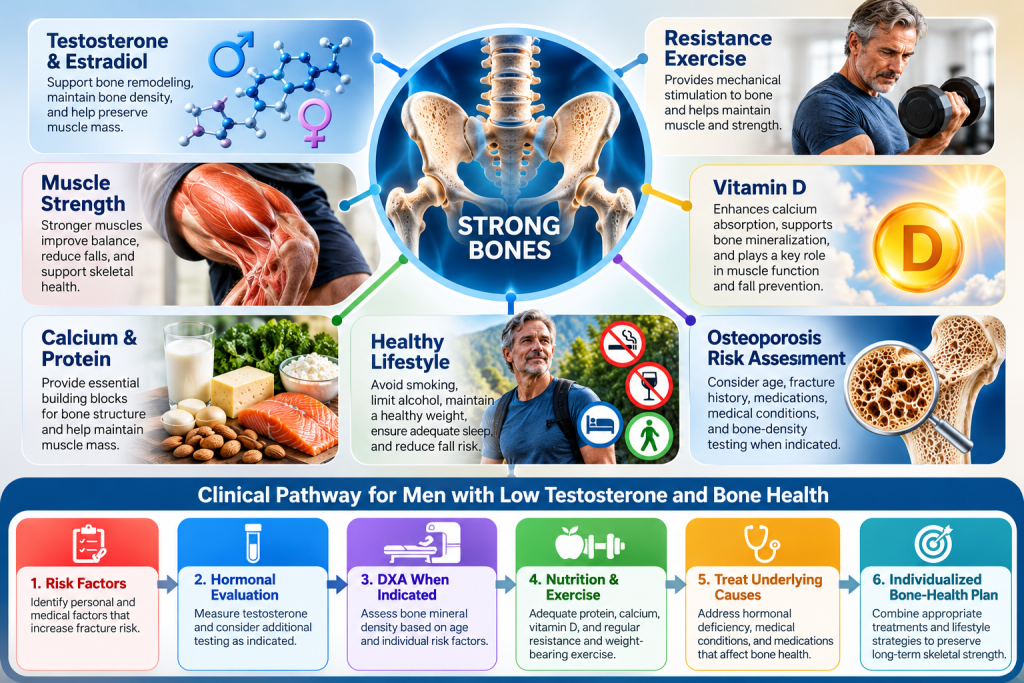
How to Evaluate Low Testosterone and Bone Health
Evaluation should consider both hormonal status and overall fracture risk. Men with persistent testosterone deficiency, previous low-trauma fractures, significant height loss, long-term glucocorticoid exposure, or other osteoporosis risk factors may warrant further assessment of skeletal health.
Testosterone assessment commonly begins with appropriately timed total testosterone measurements. When results are low or borderline, repeat testing and additional evaluation may be appropriate to confirm testosterone deficiency and investigate its cause.
Bone mineral density can be measured with dual-energy X-ray absorptiometry, commonly called a DXA or DEXA scan. Depending on age and individual risk factors, clinicians may also evaluate vitamin D status, calcium metabolism, thyroid or parathyroid disorders, kidney or liver disease, medication exposure, and other secondary causes of bone loss.
The goal is not simply to determine whether testosterone is low. It is to identify the combination of hormonal, nutritional, lifestyle, medication-related, and medical factors that may be affecting skeletal strength and fracture risk.
How to Protect Bone Health When Testosterone Is Low
Protecting skeletal health requires more than correcting a hormone level. When testosterone deficiency is confirmed, treatment should be considered within a broader strategy designed to preserve bone, muscle, balance, and physical function.
Regular resistance and weight-bearing exercise can provide mechanical stimulation to bone while helping maintain muscle strength. Adequate dietary protein, calcium, vitamin D, and overall nutritional quality also support the tissues involved in musculoskeletal health.
Smoking cessation, moderation of alcohol intake, fall prevention, and review of medications that may adversely affect bone are also important. Men with osteoporosis or high fracture risk may require specific osteoporosis treatment rather than relying on testosterone therapy alone.
The most effective approach to low testosterone and bone health is therefore individualized. Hormonal treatment, when appropriate, should complement—not replace—evaluation and management of the other factors that determine long-term skeletal strength.
The Bottom Line on Low Testosterone and Bone Health
Low testosterone and bone health are closely connected because sex hormones help regulate bone remodeling, muscle function, and long-term skeletal strength. Persistent testosterone deficiency can contribute to reduced bone mineral density and may increase osteoporosis risk in susceptible men.
However, testosterone is only one part of the picture. Age, estradiol, nutrition, vitamin D status, physical activity, muscle strength, medications, smoking, alcohol use, and other medical conditions can substantially influence bone health and fracture risk.
A comprehensive evaluation considers appropriately obtained testosterone measurements together with individual osteoporosis risk factors and, when indicated, bone-density testing and evaluation for secondary causes of bone loss.
When testosterone deficiency is confirmed, appropriate treatment may improve bone mineral density in selected men. Long-term skeletal protection should still include resistance and weight-bearing exercise, adequate nutrition, fall prevention, and specific osteoporosis treatment when clinically indicated.