
Understanding Low Testosterone and Muscle Loss
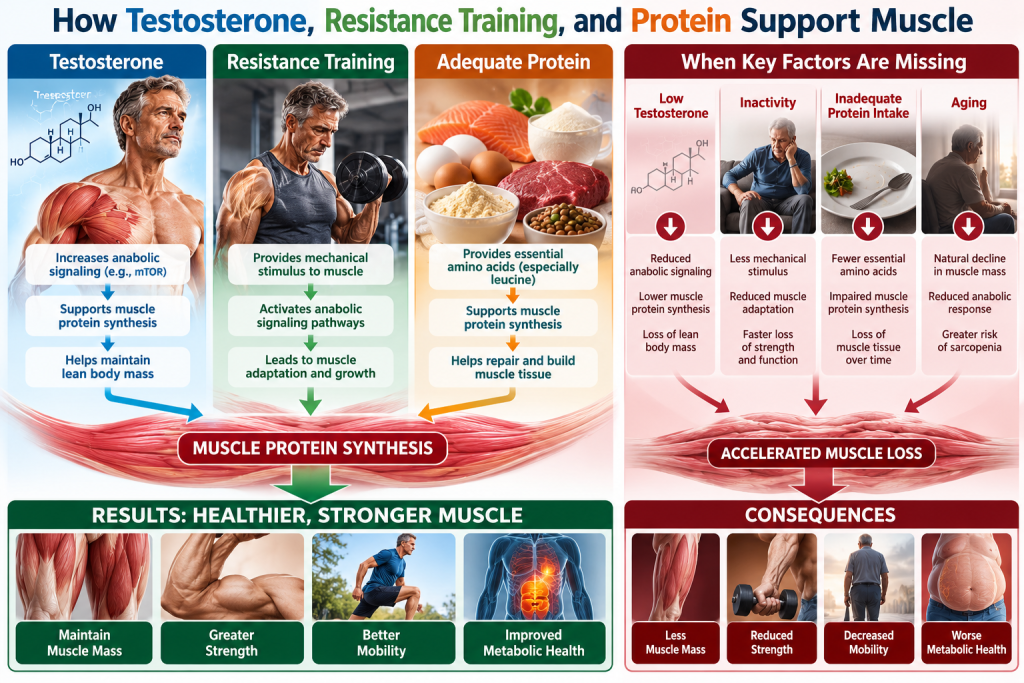
Low testosterone and muscle loss can occur together because testosterone plays an important role in maintaining skeletal muscle mass, muscle protein synthesis, strength, and overall body composition. When testosterone remains persistently low, some men may notice reduced muscle size, declining strength, slower recovery, or increasing difficulty maintaining lean body mass.
However, muscle loss is not caused by testosterone deficiency alone. Aging, inadequate resistance exercise, insufficient protein or calorie intake, chronic illness, certain medications, poor sleep, and metabolic dysfunction can all contribute to reductions in muscle mass and physical performance.
This distinction becomes increasingly important with age because progressive loss of skeletal muscle can eventually contribute to sarcopenia, reduced mobility, impaired glucose regulation, and greater risk of functional decline.
For this reason, low testosterone and muscle loss should be evaluated within the broader context of hormone status, nutrition, physical activity, metabolic health, sleep, medications, and underlying medical conditions rather than assuming that testosterone is the only factor involved.
7 Important Connections Between Low Testosterone and Muscle Loss
1. Testosterone Helps Maintain Skeletal Muscle
Testosterone contributes to the maintenance of skeletal muscle by influencing muscle protein synthesis, muscle fiber characteristics, and the balance between lean tissue and fat mass. These effects help support strength, physical performance, and healthy body composition.
When testosterone levels are persistently low, the anabolic signaling that supports muscle tissue may be reduced. Over time, some men may experience a decrease in lean body mass together with changes in strength or exercise capacity.
The relationship is not determined by testosterone alone. Resistance training, dietary protein, total energy intake, recovery, age, neurological function, and chronic disease all influence how much muscle a person maintains.
Therefore, testosterone should be viewed as one component of a larger physiological system responsible for preserving skeletal muscle rather than as the sole regulator of muscle mass.
2. Low Testosterone Can Affect Muscle Protein Synthesis
Skeletal muscle is constantly undergoing remodeling through the opposing processes of muscle protein synthesis and muscle protein breakdown. Maintaining muscle requires enough anabolic stimulation to replace proteins that are continually being degraded.
Testosterone supports anabolic signaling within muscle tissue and can influence the body’s ability to maintain lean mass. When testosterone is persistently deficient, this anabolic environment may become less favorable, particularly when combined with aging, inactivity, inadequate nutrition, or chronic disease.
Dietary protein and resistance exercise provide powerful independent signals for muscle protein synthesis. For this reason, adequate protein intake and progressive resistance training remain important even when testosterone deficiency has been identified.
Evaluating low testosterone and muscle loss therefore requires attention to both hormonal status and the nutritional and mechanical stimuli needed to preserve muscle tissue.
3. Aging Can Accelerate Muscle Loss When Testosterone Is Low
Muscle mass and strength tend to decline gradually with age. This process can accelerate when physical activity decreases, protein intake becomes inadequate, chronic disease develops, or hormonal changes occur.
Testosterone concentrations also tend to decline with age in many men, although the degree of change varies substantially between individuals. Lower testosterone may therefore coexist with age-related muscle loss, but the presence of both does not prove that testosterone deficiency is the sole cause.
Older muscle can also become less responsive to anabolic stimuli such as dietary protein and exercise, a phenomenon often described as anabolic resistance. This makes adequate protein intake and appropriately designed resistance training increasingly important for preserving lean tissue.
When low testosterone and muscle loss occur together in an older man, evaluation should consider hormonal status alongside strength, physical function, nutrition, exercise habits, medications, metabolic health, and other potential contributors to sarcopenia.
4. Muscle Loss Can Worsen Metabolic Health
Skeletal muscle is not only responsible for movement and strength. It is also a major metabolic tissue that helps regulate glucose utilization, insulin sensitivity, and overall energy metabolism.
When muscle mass declines, the body’s capacity to dispose of glucose may also decrease. Combined with reduced physical activity and increasing visceral fat, this can contribute to insulin resistance and unfavorable changes in body composition.
Metabolic dysfunction can then interact with testosterone regulation. Obesity, insulin resistance, and other cardiometabolic abnormalities are frequently associated with lower testosterone concentrations in men, creating a potentially self-reinforcing relationship between hormonal health, muscle mass, and metabolic function.
Preserving skeletal muscle is therefore important not only for strength and mobility but also for maintaining metabolic health as men age.
5. Resistance Training Becomes Even More Important
Resistance training is one of the most effective strategies for maintaining or increasing skeletal muscle. Mechanical tension created during appropriately progressive exercise stimulates muscle protein synthesis and helps preserve strength and physical function.
For men with low testosterone, resistance exercise remains important because muscle tissue continues to respond to training even when the hormonal environment is less than optimal. Exercise also provides benefits beyond muscle growth, including improved insulin sensitivity, bone health, balance, cardiovascular fitness, and metabolic function.
Training programs should be individualized according to age, baseline strength, orthopedic limitations, cardiovascular status, and previous exercise experience. Progressive overload is important, but increasing resistance too quickly can raise the risk of injury.
When low testosterone and muscle loss occur together, resistance training should generally be considered part of the broader management strategy rather than relying on hormonal treatment alone to restore lean body mass.
6. Adequate Protein Is Essential for Preserving Muscle
Dietary protein provides the amino acids required to repair and build skeletal muscle. When protein intake is inadequate, maintaining lean body mass becomes more difficult, particularly in older adults or during periods of calorie restriction, illness, or reduced physical activity.
Protein intake should be distributed across the day rather than relying on a single large serving. High-quality protein sources that provide sufficient essential amino acids, particularly leucine, can help stimulate muscle protein synthesis when combined with resistance exercise.
Total calorie intake also matters. Even adequate protein may not fully protect muscle when prolonged energy intake is substantially below the body’s needs, especially when weight loss is rapid or resistance training is absent.
For men experiencing low testosterone and muscle loss, nutritional assessment should therefore accompany hormonal and exercise evaluation so that inadequate protein or energy intake is not overlooked as a potentially modifiable contributor.
7. TRT May Increase Lean Body Mass, but It Is Not a Substitute for Exercise
In men with confirmed testosterone deficiency, testosterone replacement therapy may increase lean body mass and can improve certain measures of body composition. The magnitude of the response varies according to baseline testosterone levels, age, health status, nutrition, physical activity, and treatment duration.
An increase in lean body mass does not necessarily translate into proportional improvements in strength or physical function. Resistance training provides a mechanical stimulus that hormone therapy alone cannot replace.
TRT should therefore not be used simply as a muscle-building strategy in men without appropriately diagnosed testosterone deficiency. Treatment decisions should be based on compatible symptoms, properly obtained testosterone measurements, potential benefits, contraindications, fertility goals, and individualized clinical assessment.
For men with confirmed low testosterone and muscle loss, the strongest overall strategy may involve appropriate medical treatment when indicated together with progressive resistance training, adequate nutrition, sufficient recovery, and management of other contributors to muscle loss.
How to Evaluate Low Testosterone and Muscle Loss
When a man experiences progressive loss of muscle together with symptoms such as reduced libido, fewer spontaneous erections, fatigue, decreased strength, or declining physical performance, both hormonal and nonhormonal causes should be considered.
Testosterone evaluation commonly begins with appropriately timed total testosterone testing. If the result is low, borderline, or inconsistent with the clinical picture, repeat testing and assessment of free testosterone and SHBG may provide additional information.
Muscle health should also be evaluated beyond appearance alone. Changes in strength, exercise performance, mobility, body composition, weight, nutritional intake, and physical activity can provide important clinical information. In older adults, progressive loss of muscle accompanied by reduced strength or physical function may raise concern for sarcopenia.
The goal is to determine whether low testosterone and muscle loss reflect testosterone deficiency, age-related changes, inadequate nutrition or exercise, metabolic dysfunction, chronic disease, medications, or a combination of these factors.
Can Muscle Loss Be Reversed When Testosterone Is Low?
Muscle loss is not always permanent. Skeletal muscle retains the ability to respond to resistance exercise, adequate nutrition, and improved metabolic health across much of the lifespan, although the rate and magnitude of improvement vary between individuals.
Progressive resistance training provides the primary mechanical stimulus for rebuilding muscle. Adequate protein and energy intake provide the nutritional substrates required for recovery and muscle protein synthesis, while sufficient sleep supports exercise recovery and overall hormonal health.
When true testosterone deficiency is present, appropriately prescribed treatment may improve the hormonal environment and increase lean body mass in selected men. However, treatment works best as part of a comprehensive strategy rather than as a replacement for exercise, nutrition, and management of underlying medical conditions.
The clinical objective is therefore not simply to raise a testosterone laboratory value. It is to preserve or restore strength, lean body mass, mobility, metabolic health, and long-term physical function.
The Bottom Line on Low Testosterone and Muscle Loss
Low testosterone and muscle loss can occur together because testosterone contributes to the maintenance of skeletal muscle, lean body mass, and normal anabolic signaling. However, declining muscle mass should not automatically be attributed to testosterone deficiency.
Aging, inadequate resistance exercise, insufficient protein or calorie intake, poor sleep, metabolic dysfunction, medications, and chronic medical conditions can all contribute to muscle loss. In many men, several of these factors are present simultaneously.
A comprehensive evaluation considers testosterone levels together with symptoms, strength, physical function, body composition, nutrition, exercise habits, metabolic health, medications, and other potential causes of declining muscle mass.
When testosterone deficiency is confirmed, appropriate treatment may support improvements in lean body mass in selected men. The broader objective, however, is to preserve muscle, strength, mobility, metabolic health, and long-term independence through an individualized combination of medical care, resistance training, adequate nutrition, and recovery.
Pingback: Low Testosterone and Bone Health: 7 Critical Connections