
Understanding Low Testosterone and Belly Fat
Low testosterone and belly fat are frequently seen together in men, particularly as age, metabolic changes, and reduced physical activity begin to affect body composition. The relationship is not simply cosmetic. Abdominal fat, especially visceral fat surrounding the internal organs, is metabolically active and can influence hormonal and metabolic function.
Excess visceral fat is associated with insulin resistance, inflammation, altered sex hormone-binding globulin (SHBG), and changes in testosterone metabolism. At the same time, persistently low testosterone may contribute to reduced lean muscle mass, lower physical performance, and increased fat accumulation.
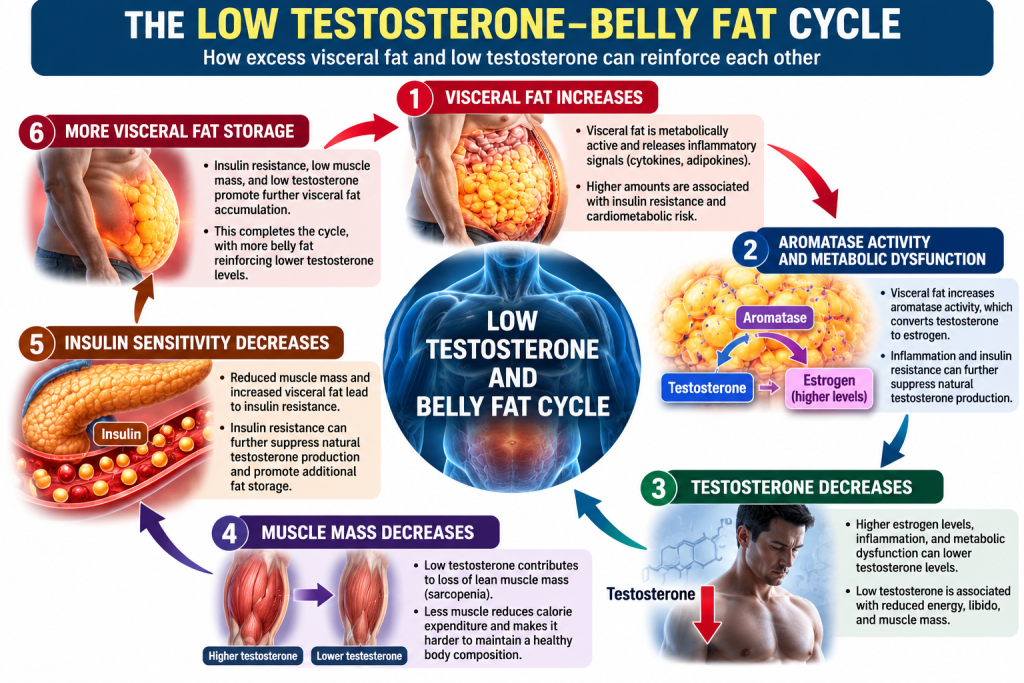
This creates a potentially self-reinforcing relationship in which increasing abdominal fat can accompany hormonal changes, while reduced testosterone may make favorable body-composition changes more difficult.
However, belly fat does not automatically mean that a man has a testosterone deficiency, and low testosterone should not be diagnosed from symptoms or body composition alone. Proper evaluation considers symptoms, appropriately performed hormone testing, metabolic health, sleep, medications, nutrition, and physical activity together.
7 Important Connections Between Low Testosterone and Belly Fat
1. Visceral Fat Is Metabolically Active
Visceral fat differs from the subcutaneous fat located directly beneath the skin. It accumulates deeper within the abdomen around internal organs and functions as metabolically active tissue rather than simply serving as stored energy.
Higher amounts of visceral fat are associated with insulin resistance, abnormal lipid metabolism, chronic low-grade inflammation, and increased cardiometabolic risk. These metabolic changes can also interact with the hormonal systems involved in testosterone production and availability.
For this reason, waist circumference and abdominal fat distribution may provide clinically useful information beyond body weight or body mass index alone. Two men with similar body weights can have substantially different amounts of visceral fat and different metabolic risk profiles.
Understanding the type and distribution of body fat, therefore, helps place testosterone levels and metabolic findings into a broader clinical context.
2. Belly Fat Can Affect Testosterone Metabolism
Abdominal adipose tissue can influence the hormonal environment through several biological pathways. Fat tissue contains aromatase, an enzyme involved in converting androgens such as testosterone into estrogens.
As adipose tissue increases, aromatase activity may also increase. However, the relationship between obesity, testosterone, and estrogen is complex and should not be reduced to aromatase activity alone. Changes in insulin sensitivity, inflammatory signaling, SHBG, and hypothalamic-pituitary-testicular function may also contribute to lower testosterone levels in men with obesity.
This helps explain why abdominal obesity and lower testosterone concentrations frequently occur together. It does not establish that belly fat alone causes testosterone deficiency or that reducing estrogen is necessarily an appropriate treatment.
Hormone results should therefore be interpreted within the complete metabolic and clinical picture rather than focusing on testosterone or estradiol in isolation.
3. Insulin Resistance Links Belly Fat and Testosterone
Visceral abdominal fat is strongly associated with insulin resistance, a condition in which cells become less responsive to insulin. The pancreas may compensate by producing more insulin to maintain normal blood glucose levels.
Insulin resistance is also associated with lower SHBG concentrations. Because SHBG carries testosterone in the bloodstream, lower SHBG can reduce measured total testosterone and make hormone results more difficult to interpret without additional clinical context.
Over time, insulin resistance may progress alongside other metabolic abnormalities, including elevated blood glucose, abnormal triglycerides, reduced HDL cholesterol, and increased blood pressure.
For men with low testosterone and belly fat, evaluating glucose regulation and other metabolic risk factors can therefore be as important as evaluating testosterone itself.
4. Low Testosterone May Contribute to Loss of Muscle Mass
Testosterone plays an important role in maintaining skeletal muscle mass and supporting muscle protein synthesis. When testosterone remains persistently low, some men may experience reductions in lean body mass, strength, and physical performance.
Loss of muscle can also affect metabolic health. Skeletal muscle is a major site for glucose utilization, and maintaining adequate muscle mass supports insulin sensitivity and energy expenditure.
As lean mass decreases and physical activity declines, gaining abdominal fat may become easier. This can contribute to a body-composition pattern characterized by less muscle and greater visceral adiposity.
Resistance training, adequate dietary protein, appropriate caloric intake, recovery, and treatment of underlying medical conditions are therefore important considerations when evaluating low testosterone and belly fat.
5. Poor Sleep Can Promote Belly Fat and Affect Testosterone
Sleep influences hormone secretion, appetite regulation, glucose metabolism, and recovery. Chronic sleep restriction or fragmented sleep can negatively affect several of these systems at the same time.
Insufficient sleep may impair insulin sensitivity and alter hormones involved in hunger and appetite, potentially making weight management more difficult. Testosterone secretion is also closely linked to normal sleep architecture, so persistent sleep disruption may influence testosterone levels.
Obstructive sleep apnea is particularly relevant because it commonly occurs in men with abdominal obesity. Loud snoring, witnessed pauses in breathing, morning headaches, daytime sleepiness, and unrefreshing sleep can suggest the need for further evaluation.
For men experiencing both hormonal symptoms and increasing abdominal fat, sleep quality should therefore be considered as part of the overall clinical assessment.
6. Losing Visceral Fat May Support Testosterone Levels
Reducing excess body fat, particularly visceral abdominal fat, can improve several markers of metabolic health. Weight reduction in men with overweight or obesity may improve insulin sensitivity, glucose regulation, blood pressure, lipid levels, and inflammatory status. This is one reason low testosterone and belly fat should be evaluated together when abdominal obesity and metabolic dysfunction are present.
Improvements in body weight and metabolic health may also be accompanied by increases in testosterone concentrations in some men. The response varies according to the amount of weight lost, baseline metabolic health, age, and other individual factors.
Resistance training can be particularly valuable because the objective is not simply to lose weight but to reduce excess fat while preserving or increasing lean muscle mass. Combining resistance exercise with appropriate nutrition, adequate protein, aerobic activity, and sufficient sleep supports this goal.
Lifestyle improvement does not replace appropriate evaluation when testosterone deficiency is suspected. Persistent symptoms and repeatedly low testosterone measurements may still require further investigation even after substantial improvements in body composition.
7. Belly Fat Does Not Automatically Mean You Need TRT
The presence of abdominal obesity does not establish testosterone deficiency. Many men with excess belly fat have testosterone levels that do not meet diagnostic criteria for hypogonadism, while others may have low total testosterone partly because obesity and insulin resistance can affect SHBG concentrations.
When testosterone deficiency is suspected, diagnosis should be based on compatible symptoms together with appropriately obtained and, when indicated, repeated testosterone measurements. Free testosterone and SHBG may provide additional information when total testosterone is borderline or difficult to interpret.
It is also important to identify potentially reversible contributors, including obesity, sleep apnea, certain medications, acute illness, inadequate nutrition, and metabolic dysfunction.
Testosterone replacement therapy may be appropriate for selected men with confirmed testosterone deficiency, but it should not be used simply as a treatment for abdominal fat. The clinical objective is to identify and address the factors responsible for both the hormonal findings and the changes in body composition.
How to Evaluate Low Testosterone and Belly Fat
When a man has increasing abdominal fat together with symptoms such as reduced libido, fewer spontaneous erections, fatigue, decreased strength, loss of muscle mass, or reduced physical performance, both hormonal and metabolic factors should be considered. Recognizing this pattern can help clinicians evaluate low testosterone and belly fat within the same metabolic and hormonal framework.
Testosterone evaluation commonly begins with appropriately timed total testosterone testing. If the result is low, borderline, or inconsistent with the clinical picture, repeat testing and assessment of free testosterone and SHBG may provide additional information.
Metabolic evaluation may include waist circumference, blood pressure, fasting glucose or hemoglobin A1c, lipid levels, and assessment of other cardiovascular risk factors. Sleep quality, medications, alcohol intake, nutrition, physical activity, and medical conditions that can affect body composition or hormone levels should also be reviewed.
The goal is not simply to determine whether testosterone is low or whether abdominal fat is excessive. The objective is to identify the combination of hormonal, metabolic, and lifestyle factors contributing to the patient’s symptoms and body-composition changes.
Can Reducing Belly Fat Improve Testosterone?
For men with overweight or obesity, reducing excess body fat can improve metabolic health and may also support healthier testosterone levels. Research has shown that weight loss in men with obesity can be accompanied by increases in testosterone, although the magnitude of the response varies considerably among individuals.
The most useful strategy generally focuses on improving body composition rather than simply reducing the number on the scale. Preserving or increasing skeletal muscle while reducing visceral fat can support insulin sensitivity, physical function, and long-term metabolic health.
Resistance training, regular aerobic activity, adequate dietary protein, appropriate calorie intake, sufficient sleep, and treatment of conditions such as obstructive sleep apnea or diabetes can all contribute to this process.
However, improvement in body composition does not guarantee that testosterone deficiency will resolve. Men who continue to experience compatible symptoms despite meaningful metabolic improvement may still require appropriate hormonal evaluation and individualized treatment.
The Bottom Line on Low Testosterone and Belly Fat
Low testosterone and belly fat can be closely interconnected, particularly when visceral obesity, insulin resistance, reduced muscle mass, poor sleep, and other metabolic factors are present. However, neither condition should automatically be assumed to cause the other.
Abdominal fat can influence hormone metabolism and metabolic function, while persistently low testosterone may contribute to unfavorable changes in lean muscle mass and body composition. This interaction can create a cycle that becomes increasingly difficult to reverse if the underlying factors are not addressed.
A comprehensive approach evaluates testosterone levels together with symptoms, waist circumference, glucose regulation, cardiovascular risk factors, sleep, nutrition, physical activity, medications, and overall metabolic health.
For some men, improving body composition and metabolic health may support healthier testosterone levels. Others may have persistent testosterone deficiency requiring additional evaluation. Proper testing helps determine which factors are contributing and which treatment strategies are appropriate.
Pingback: Low Testosterone and Sleep: 7 Critical Connections