
Understanding Low Testosterone and Sleep
Low testosterone and sleep are closely connected because normal testosterone production follows a daily rhythm that is strongly influenced by sleep. In healthy men, testosterone levels generally rise during sleep and are typically highest during the morning hours.
When sleep is consistently shortened, fragmented, or disrupted, normal hormonal rhythms may be affected. At the same time, symptoms associated with inadequate sleep—such as fatigue, reduced motivation, difficulty concentrating, decreased exercise performance, and lower sexual interest—can resemble symptoms sometimes attributed to testosterone deficiency.
Sleep disorders can further complicate the relationship. Obstructive sleep apnea, obesity, metabolic dysfunction, medications, alcohol use, and aging may influence both sleep quality and hormonal health.
For this reason, low testosterone and sleep should be evaluated together when symptoms overlap. Identifying chronic sleep restriction or an untreated sleep disorder may reveal an important and potentially modifiable contributor to a man’s symptoms.
7 Important Connections Between Low Testosterone and Sleep
1. Testosterone Production Is Linked to the Sleep Cycle
Testosterone secretion follows a circadian and sleep-related pattern. In many men, testosterone levels begin to rise after sleep begins, increase during the night, and reach higher concentrations during the early morning hours.
This pattern helps explain why testosterone testing is commonly performed in the morning, particularly when evaluating younger and middle-aged men for possible testosterone deficiency.
Normal sleep architecture also appears to matter. Repeated awakenings and fragmented sleep can interfere with the physiological processes that normally occur across the different stages of sleep.
The relationship between low testosterone and sleep is therefore not simply about the number of hours spent in bed. Sleep continuity, timing, and quality may also influence normal hormonal rhythms.
2. Short Sleep May Reduce Testosterone Levels
Consistently obtaining too little sleep may interfere with normal testosterone production. Experimental sleep-restriction studies have reported reductions in daytime testosterone levels after periods of restricted sleep, although the magnitude of the effect varies among studies and individuals.
Sleep loss can also increase fatigue, reduce exercise capacity, alter appetite regulation, and affect mood and sexual interest. These effects can make inadequate sleep resemble—or amplify—the symptoms associated with testosterone deficiency.
A single poor night of sleep does not establish a hormonal disorder. The greater concern is a persistent pattern of insufficient or disrupted sleep, particularly when accompanied by daytime symptoms.
When low testosterone and sleep problems occur together, sleep duration and quality should therefore be reviewed before assuming that every symptom is caused by testosterone deficiency alone.
3. Obstructive Sleep Apnea Can Complicate the Picture
Obstructive sleep apnea causes repeated episodes of partial or complete upper-airway obstruction during sleep. These events can produce intermittent reductions in oxygen levels, repeated awakenings, and substantial disruption of normal sleep architecture.
Men with obstructive sleep apnea may experience daytime fatigue, reduced concentration, mood changes, decreased sexual function, and poor exercise tolerance. Several of these symptoms overlap with those commonly associated with testosterone deficiency.
Sleep apnea is also strongly associated with obesity and cardiometabolic disease, which can independently influence testosterone levels. This makes it difficult to attribute hormonal changes to sleep apnea alone in every individual.
When low testosterone and sleep symptoms occur alongside loud snoring, witnessed breathing pauses, morning headaches, or excessive daytime sleepiness, evaluation for obstructive sleep apnea may be appropriate rather than treating the hormonal finding in isolation.
4. Obesity Can Affect Both Sleep and Testosterone
Obesity can create an important link between disrupted sleep and altered testosterone physiology. Excess body fat, particularly visceral adiposity, is associated with metabolic changes that can influence the hypothalamic-pituitary-testicular axis and circulating testosterone levels.
Obesity also substantially increases the risk of obstructive sleep apnea. Repeated airway obstruction, fragmented sleep, and intermittent reductions in oxygen can further contribute to fatigue, impaired daytime function, and poor sleep quality.
The relationship can become self-reinforcing. Poor sleep may negatively affect appetite regulation, insulin sensitivity, energy levels, and physical activity, while increasing body weight can worsen sleep-disordered breathing and metabolic health.
For men with low testosterone and sleep problems who also have excess body fat, addressing weight, metabolic health, physical activity, and possible sleep apnea may be an important part of the overall clinical strategy.
5. Poor Sleep Can Mimic Symptoms of Low Testosterone
Fatigue, reduced motivation, difficulty concentrating, irritability, decreased exercise performance, and lower sexual interest are frequently associated with inadequate or disrupted sleep. Many of these symptoms also appear on lists of possible testosterone-deficiency symptoms.
This overlap can make symptoms alone unreliable for determining whether testosterone is actually low. A man who sleeps poorly may feel as though he has a hormonal problem even when testosterone levels are within the expected range.
Conversely, confirmed testosterone deficiency and a sleep disorder can coexist. In that situation, treating only one problem may leave important symptoms unresolved.
When evaluating low testosterone and sleep complaints, clinicians should therefore consider sleep duration, sleep quality, work schedules, insomnia, sleep apnea symptoms, medications, alcohol use, psychological health, and other potential causes of daytime fatigue before attributing nonspecific symptoms to testosterone alone.
6. Age Can Change Both Sleep Patterns and Testosterone Levels
Sleep architecture changes with age. Older adults often experience lighter sleep, more nighttime awakenings, earlier waking, and changes in the amount of time spent in different sleep stages.
Testosterone levels also tend to decline gradually with age in many men, although the degree of change varies considerably. Health status, obesity, medications, chronic disease, and lifestyle can influence testosterone independently of chronological age.
Because both sleep and hormonal physiology change over time, fatigue or reduced vitality in an older man should not automatically be attributed to either aging or testosterone deficiency.
When low testosterone and sleep problems develop with advancing age, evaluation should consider the broader clinical picture—including sleep disorders, cardiometabolic health, medications, physical activity, and appropriately obtained testosterone measurements—rather than assuming that either finding is simply an unavoidable consequence of aging.
7. TRT and Sleep Apnea Require Careful Clinical Consideration
Testosterone replacement therapy may improve symptoms in appropriately selected men with confirmed testosterone deficiency, but sleep-disordered breathing should also be considered when evaluating treatment.
Untreated severe obstructive sleep apnea is an important clinical consideration when deciding whether to initiate testosterone therapy. Men with symptoms suggestive of sleep apnea may require appropriate evaluation and treatment of the sleep disorder as part of their overall care.
Monitoring also matters after therapy begins. Changes in snoring, witnessed breathing pauses, daytime sleepiness, sleep quality, hematocrit, and other relevant clinical findings may warrant reassessment.
The relationship between low testosterone and sleep therefore, remains important even after testosterone deficiency has been confirmed. Hormonal treatment should be integrated with appropriate management of sleep apnea, obesity, metabolic health, and other conditions that may affect both sleep and testosterone physiology.
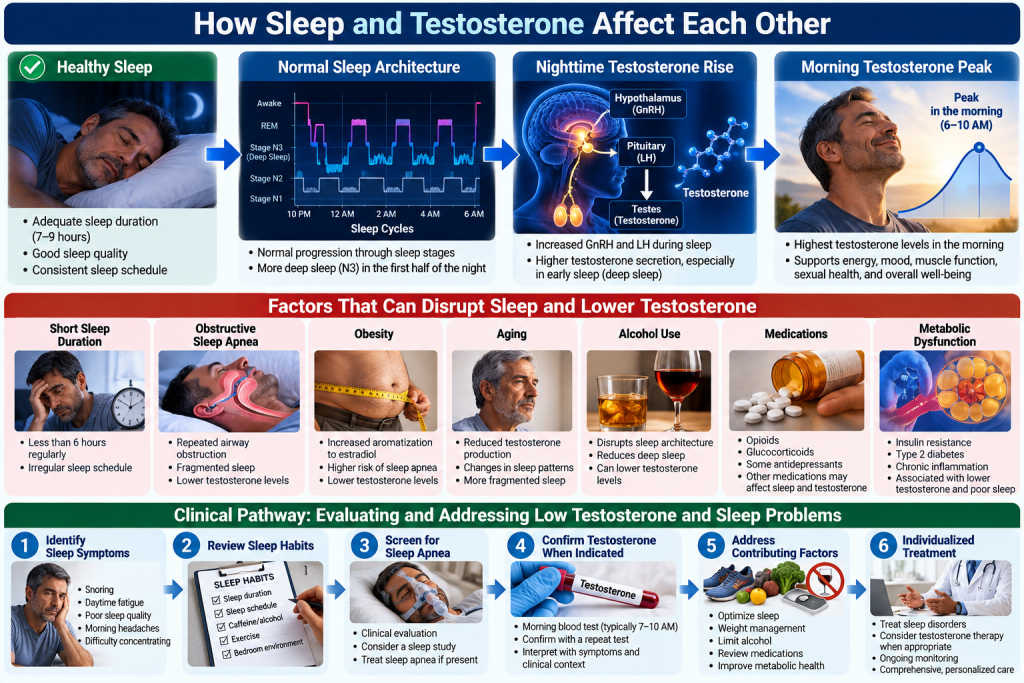
How to Evaluate Low Testosterone and Sleep Problems
Evaluation should determine whether symptoms are primarily related to testosterone deficiency, inadequate sleep, a sleep disorder, another medical condition, or several factors occurring together.
A detailed history should include usual sleep duration, bedtime and wake time, nighttime awakenings, shift work, insomnia, snoring, witnessed breathing pauses, morning headaches, daytime sleepiness, medications, alcohol use, body-weight changes, and cardiometabolic risk factors.
When testosterone deficiency is suspected, appropriately timed testosterone measurements are important. Low results generally require confirmation, while additional laboratory evaluation may be appropriate depending on the clinical circumstances.
Men with symptoms suggestive of obstructive sleep apnea may require formal sleep evaluation. Identifying and treating a sleep disorder can be important not only for daytime energy and quality of life but also for cardiovascular and metabolic health.
The objective when evaluating low testosterone and sleep is to distinguish overlapping symptoms from true hormonal deficiency while identifying potentially treatable sleep and metabolic conditions.
How to Improve Sleep When Testosterone Is Low
Improving sleep begins with identifying the reason sleep is inadequate or disrupted. Simply spending more time in bed may not correct insomnia, sleep apnea, circadian disruption, or other conditions that interfere with restorative sleep.
Maintaining a consistent sleep and wake schedule, allowing adequate time for sleep, exercising regularly, limiting excessive alcohol intake, and reducing late-day caffeine can support healthy sleep patterns. A dark, quiet, and comfortable sleep environment may also improve sleep quality.
Men who snore heavily, experience witnessed breathing pauses, awaken gasping, or have significant daytime sleepiness should consider evaluation for obstructive sleep apnea rather than relying on sleep-hygiene measures alone.
Weight management can also be important, particularly when obesity, metabolic dysfunction, and sleep apnea coexist. Improving these factors may benefit sleep quality, cardiovascular health, metabolic function, and overall well-being.
For men with low testosterone and sleep problems, the most effective approach is individualized: confirm whether testosterone deficiency is truly present while simultaneously identifying and treating the factors disrupting healthy sleep.
The Bottom Line on Low Testosterone and Sleep
Low testosterone and sleep have a complex, bidirectional relationship. Normal testosterone secretion is influenced by sleep timing and quality, while insufficient or fragmented sleep can affect hormonal rhythms and produce symptoms that resemble testosterone deficiency.
Obstructive sleep apnea, obesity, metabolic dysfunction, aging, medications, alcohol use, and lifestyle factors can further influence both sleep and testosterone levels. This overlap makes careful evaluation particularly important.
A low testosterone result should therefore be interpreted alongside symptoms, properly timed and confirmed laboratory testing, sleep quality, body composition, metabolic health, and possible sleep disorders.
For men with confirmed testosterone deficiency, appropriate treatment may be beneficial, but optimizing sleep remains an important part of overall health. Identifying and treating sleep apnea or other causes of disrupted sleep can improve daytime function while addressing cardiovascular and metabolic risks that testosterone therapy alone cannot correct.